
Best Matches Seen November 2025 |
NJPW 4/30/91 Tokyo Ryogoku Kokugikan, Top of the Super Juniors II Semi Final: Pegasus Kid vs. Norio Honaga 9:21.
DC: The winner of this bout would face the winner of Jushin Thunder Liger vs. Negro Casas (which would turn out to be Liger) in the final. Pegasus wasted no time and immediately attacked Honaga. Pegasus was in control for a bit until Honaga avoided a plancha attempt. Honaga hit a pescado and was in control now. Things got more exciting once they exchanged German suplexes. Honaga is definitely not your most exciting wrestler, but he’s a sneaky veteran who can score a victory out of nowhere. That’s what made him so dangerous and made his pinfall attempts interesting. Honaga was definitely a solid worker who knew what he was doing. It’s just that for a guy that unspectacular (compared to almost everyone else in the division), it felt like he was a bit overpushed. And it’s a shame Pegasus didn’t advance to the final, but I guess we’ve already been spoiled enough when it comes to Pegasus vs. Liger matches. All in all, the fact that this was short worked to everyone’s advantage, because that forced Honaga to go along with Pegasus’ wish for a high-paced approach. This was essentially Pegasus practicing for the future, as this resembled a Nitro match in some ways. However, because this type of sprint usually wasn’t the norm for somewhat important matches in NJPW at the time, it felt on one hand like it was lacking something due to the relatively short time this lasted, yet on the other hand it felt refreshing and exciting. The main issue of the match really was the fact that Honaga’s rather simplistic moveset limited them from having a match that would live up to what you’d think a TOSJ semi-final would be like. Also, by this point in time, Pegasus had never proven himself to be capable of working an excellent match against someone other than Liger (with the only exception being the excellent 6/26/90 match against fellow Albertan Owen Hart). With all of that in mind, this merely felt like a fun little side attraction compared to the semi-final and final involving Liger. Good match. ***¼
8/16/25 NJPW G1 Climax 2025 Semifinal: Konosuke Takeshita vs. Zack Sabre Jr. 26:46
ML:
This match had an odd dynamic because NJPW has yet to figure out what Takeshita's personality here is supposed to be. He was an outsider heel because he's a DDT guy who went to AEW, but suddenly, with no actual angle or story, they just kind of decided he was a face for the final few matches against two foreigners then the lazy heel EVIL, seemingly wondering why he wasn't fully embraced in any of these.
This wasn't Takeshita's greatest performance, but in fairness, he was already in survival mode after a long grueling tournament where he ultimately surpassed the total G1 Climax match time record by 10 seconds. Takeshita's knee was already injured, and got worse when he was powerbombed through 2 tables by Unfit Finlay in his playoff match on 8/14/25. Takeshita was knocked silly by ZSJ here, and was said to have not remembered this match or his post-match promo, which sounds like a potential concussion, but he worked a 26+ minute final against NJPW's scourge to wrestling as sport, EVIL, the next night anyway. Any or all of this may or may not have contributed to why this wasn't as good as their 7/30/25 league match. Takeshita has yet to truly figure out how to move with Sabre, but today he was instead relying on phony writhing and nonsensical slow crawling in between his occasional power move comeback. This was another 4 minutes longer than their league match that was already too long. This match was really hampered by Takeshita not having a grappling pedigree. As always, if your answer for basically every submission is simply to do the slow overdramatic crawl to the ropes, your match is never going to get a high rating from me. The main problem is Takeshita just let Sabre pose him rather than showing any sort of counters or even just escapes. What technical wrestling Takeshita has was basically just holding on to Sabre, which can maybe work in an 80s setting if you are doing bursts in and out of the submissions like Steamboat, but otherwise really falls flat. Beyond them not working nearly as well with one another as they did individually, the match lacked urgency, as a match with this much time on the mat shouldn't also feel like they are just kind of standing around when they do get to their feet. After the initial technical wrestling, Takeshita didn't really do anything that wasn't a big move, and was almost always one and done, so it felt like he was getting outwrestled, but he also didn't need to do as much. They were able to get over the concept that Sabre was a lot more consistent, while Takeshita was the monster who did big damage with anything he was successful with. This would have worked a lot better though if Takeshita did a better job when he was on the receiving end. Takeshita is one of the best takers when his opponent is doing the usual Lucha Libre sort of match against Ospreay, Omega, or ELP where Takeshita is the base for the opponent's flying, and then counters into a few big bombs, but he wasn't really doing anything to make ZSJ's offense better, and ZSJ isn't really exciting when the opponent is just sitting in his holds making silly faces. Sabre still did a good job of making his technical wrestling seem vicious and sadistic, but the artistry was lacking because only 1 artist was really working. They established the danger of Takeshita's big moves and Sabre's submissions though, so it generally felt like they were doing important things, even though the match always seemed far away from actually ending. Sabre was doing a nasty job of working the right elbow and hand early, including stomping on the elbow with Takeshita on the ring apron, but Takeshita came back with a DDT off the apron. ZSJ didn't force attacking the injured knee, perhaps because it was best left alone. He landed one big kick when Takeshita was stuck in the corner after missing a big charging front kick. Sabre then continued to work it because Takeshita wasn't able to get back to his feet quickly enough, but for the most part, he was opportunistic with it. Takeshita's attempts to sell the damage in between his own offense remained unconvincing, at best. Sabre avoided the running knee, and had to chain three different flash pins before he felt one could work well enough to get a near fall. Takeshita eventually hit an avalanche raging fire, which allowed him to finally be able to follow up. He hit the power drive knee, and a regular raging fire for the win, avenging his loss in the league portion. In the end, even though things went in reverse from their initial meeting, these guys have too much talent not to recommend. One of them may need to improve at the style of the other to truly make this program reach the level their individual talent would suggest it could, but just doing an energetic 15 minute match like both are actually much better at with virtually any opponent would be a good start towards figuring out a more effective way to make what both have to offer come together more effectively into a whole. ***
11/2/91 ASW World Middleweight Title Decision: Danny Boy Collins vs. Owen Hart R7 1:21
ML:
Owen started back with WWF 10 days later, showing up for the Wrestling Challenge tapings for a couple jobber matches, teaming with brother in law Jim Neidhart before embarking on one final CWA tour then going full-time with WWF in December. This should have been an excellent match, but Owen's heart wasn't fully into it. It was sort of a Dean Malenko style technical match where it had great potential to be exciting, but ultimately spent a lot of time not doing much to set up bursts of impressive activity that reminded you how good the match could be if they did more of this. The technical wrestling was ultimately kind of disappointing, not because they lacked the talent to make it excellent, but because their mentality was it was a long match so they needed to conserve their energy. This didn’t really get going until the 4th round when they committed to mostly working standing, and from that point it's definitely worth recommending. The 2nd half was more of a junior style match, and this was definitely closer to their potential because they started putting the work in. Collins was totally able to hang with Owen, in fact he looked about equally good. This just needed someone to light a fire under the other to really get it going. The first half was first gear, and the second half was only second gear, but they have enough talent that they still did a relatively worthwhile match without pushing themselves. Owen did his enzuigiri in the 7th before losing to the only devastating move of the match, the piledriver. **3/4
11/26/25 AEW Continental Classic 2025 Gold League: Kevin Knight [3] vs. Darby Allin [0] 11:56
ML:
This was surprisingly better than Darby's PPV match against PAC, which I was expecting to actually like, but PAC was uncharacteristically uninspiring, and the match dragged whenever he was in control. This was a lot faster paced and more spectacular, with Knight stealing the show with his offense, which may have been a necessity given Darby was trying to tell the story of being banged up from getting burned, and hurt his knee early in this match. They got off to a good running oriented start, making me think the plan was to do a match that was a bit more competitive and counter oriented. Darby's right ankle somehow landed on the middle rope when he was trying to land on his feet to counter Knight's monkey flip, which surely didn't do wonders for his knee. This seemingly changed the course of the match somewhat, even though Darby was most likley going to be in the injured underdog roll anyway. From here, Knight was mostly showing off his spectacular offense, with Darby sneaking in a hope spot here and there. Darby crashed the barricade when Knight avoided his charge then Knight immediately hit a fantastic moonsault attack off the adjacent barricade. Darby hit a tope con giro, but possibly because of the injury, he didn't make it through the middle rope cleanly. Knight did a big no touch lariat onto the ramp. Knight didn't really attack the knee because he doesn't really do anything but jump around, to the point that when he finally hit the coast to coast missile kick, you kind of felt like Darby hanging by his knee in the tree of woe was incidental. Knight then hit his UFO splash for the win. The problem with this match is Darby never really mounted a big enough comeback to make it dramatic. It was kind of like you kept waiting for this to actually become competitive, and most likely for Darby to still pull it out, but they stuck with the too injured to really compete bit, so this was mostly good as a showcase of Knight's flying. Darby, of course, takes really well and is a sympathetic underdog, even if the crowd didn't get as much offense from him to get behind as they expected. This was a bigger win for Knight on paper than it felt like in real life because they played it out like a foregone conclusion. ***
9/11/94 Cal International Aftershock: Sabu vs. Al Snow 16:15
ML:
The match itself was the better Sabu style, basically a junior heavyweight match with a handful of table and chair spots, the famous post match brawl was the worst Sabu style, mostly aimless brawling with a few table and chair spots, although to a large extent Snow was responsible for the relative tightness of the match and Terry Funk was responsible for the relative looseness of the post match. Sabu & Snow were back to doing a regular match since the nonsense was reserved for afterwards, so they sped things up and leaned into their flashy junior heavyweight style. This was still ahead of it's time for America though the winds were finally starting to blow in the juniors favor, and offensively more or less as exciting as most of the junior stuff in Japan, just not as precise and well rounded. Sabu took some wild sick bumps as usual, including landing on a chair when he missed his tope then getting powerbombed on the concrete. He also splatted when he tried a sunset flip powerbomb to the floor, but Snow hung on to the top rope. Sabu seemed to get a little injured overshooting a table with a moonsault on the outside, so Snow put Damien, who was Sabu's second tonight, through the table with a powerbomb. Sabu recovered and soon won with the slingshot guillotine leg drop with Snow on a chair. Damien attacked Snow after the match, so Funk, who wasn't even booked on the show, shockingly showed up and took him out, then brawled with Sabu for several minutes, wrecking him with chairs. This was one of the longest post match fights all over the building you'll see, with Snow eventually getting involved again. I remember the VHS I had it on ran out before the end. The post match was nowhere near the quality of the actual match, it involved the washed up hasbeen Terry Funk who had been Sabu's lamest feud during this time period, with Taz quickly closing the gap, but as post-match brawls go, this was pretty cool, especially since it was after the main event, so it was basically free wrestling keeping the audience entertained for an extra 10 minutes after a match that wasn't truncated or ruined in any way with the idea that the aftermath would make up for it. This part wasn't good wrestling, but the fact that it was just guys fighting for the hell of it made that more okay than when they do this and claim it's a match. The ruckus seemed to be over when Sabu performed his ceremonial moonsault through a table, but Snow and Funk were still going at it on the outside of the ring. Somehow it spilled into the parking lot, and eventually there's a cut to Funk emerging from underneath a van in the parking lot, ranting and raving like an old fool at the downed ref and anyone else who will give him the time of day. ***3/4
7/12/80 CWA: Mile Zrno vs. Charly Verhulst R4
ML:
Zrno was an amateur wrestling champion from Bosnia who mainly wrestled in Austria's CWA, but toured Japan for IWE, NJPW as Silver Hurricane where he worked against Tiger Mask, and presumably through that connection was invited to the original UWF for his technical ability. He was trained by Verhulst (Johnny Londos), so they were very much in sync, and worked a gymnastic technical style combining aspects of WOS and the Japanese junior style. He was a very impressive and fluid mover, the sort that things seemed to come naturally to. He did the 80s high flying staples such as the dropkick, flying headscissors, and monkey flip, but with more flair and precision. I liked his jumping snapmares. Verhulst was a 41-year-old from Belgium trained by Karl Gotch. He looked his age physically, but could still move quite well. Nonetheless, his job here was more to make a quick entry to gain the initial advantage to set up Zrno's arsenal of bridges and escapes. I liked him, but he seemed like the standard crafty good European wrestler at this point, where Zrno was a next level athlete with charisma. Some of the best spots were one guy taking the other down by the arm and holding on as the opponent tried to roll to freedom. One of the cool things about this match is it didn't stick to a prescribed style. They did some of the European lockups and leverage into the takedown, with active matwork on the ground until someone got loose, but other times they would run or jump when they were on their feet. In the 4th round, they just started doing what felt more like Lucha Libre than even a conventional junior style until Verhulst turned Zrno's high cross body into a powerslam for the win. The video quality wasn't very good, but we are lucky to have this gem, especially since this is presumably Zrno around his prime (7 years in), whereas most of the available footage seems to be from the 90s after the catch wrestling era of European wrestling had ended. ****
9/9/94 NWA Independent World Title Lumberjack Match: Sabu vs. Al Snow 13:37
ML:
These two kept having strong matches that didn't look the same. Snow was very versatile, Sabu was at the end of the period where he was arguably the most innovative wrestler (he was starting to settle into doing the same basic things in the later part of 94), and the variety of gimmick matches kept their program interesting. Snow was doing his own thing in this match to negate Sabu rather than trying to match or mimic him. He was countering what Sabu was throwing at him and putting him in submissions early then using suplexes and power moves later. He still did some flying, but it was his flying. Sabu was showing excellent aerial offense, as usual. The lumberjacks acting as catchers allowed for some misses they wouldn't normally be able to do safely, for instance Sabu taking a few out when he missed a quebrada. Later, one of the lumberjacks tried to hold Snow, but Snow escaped just in time, so Sabu actually wound up doing a slingshot tijeras to the lumberjack. Snow tried to follow with a swandive plancha, but he also took out the lumberjacks. Snow hit a swandive kneedrop then missed a lionsault of the top rope. Sabu came back with a tijeras, then the lights inexplicably went out as the hit simultaneous lariats. All the lumberjacks were, for some reason, brawling in the ring when the lights came back on. There was no build up to this whatsoever, none of the usual lumberjacks at each other's throats stuff, and you'd think this type of match would actually have to have a real finish, but they threw it out when the Peewee couldn't restore order. This was every bit as bad as your random early 80s Baba finish, but what came before was still impressive enough to recommend it. ***1/2
NJPW 2/10/91 Komogane Civic Gym: Pegasus Kid & Franz Schumann vs. Hiroshi Hase & Kensuke Sasaki 10:24.
DC: Franz Schumann was an Austrian wrestler who spent most of his career in the Austrian CWA league. Apart from this random tour in February ‘91, he also toured NJPW as part of the BOSJ III tournament in 1996. Schumann was quite capable of some nice technical sequences, which he was able to show here. Considering that he would seemingly be out of his element here, Schumann did quite well for himself, showing that he was a smart and versatile worker. It felt like he was a better fit for the NJPW junior heavyweight division than Fit Finlay was, for example. Pegasus was obviously no stranger to his opponents. Pegasus had wrestled Sasaki many times, as Sasaki was one of Pegasus’ main opponents when he was still a young lion in 1987. Pegasus had wrestled Hase several times in tag team competition in NJPW, and even in a singles match in Calgary. Pegasus’ style by this point was that of a NJPW worker, with a lot of focus on intensity and snugness. Hase was really eager to wrestle Pegasus, which was really cool to see. Whenever those two were in the ring together, the action was truly outstanding. Pegasus hit a tremendous superplex and a tremendous flying headbutt. Hase was superb with his timing and accuracy. Sasaki was a solid tag team worker, but he was really the least memorable worker of this match. He played his part in the finish quite well, though. When Pegasus and Hase were done wowing the crowd with their top-level work, Sasaki caught Schumann in a powerslam just as Schumann had been tagged in. The finish was quite abrupt, but it didn’t take away from the overall enjoyment of this match. Very good match. ***½
9/7/94 FMW: Sabu vs. Damien 14:33
ML:
I've watched most of Sabu's available matches from 1993 & 1994 from every league but FMW, as they mostly wasted him in barbed wire matches against guys that, well, belonged in barbed wire matches. Damien has never been one of my favorites because he's more of an imitation based comedy wrestler, and he might be the slowest rope runner of anyone under 300 pounds, but he's a decent worker when he actually wants to be, and tonight he was trying. He started off doing a big ballerina leap over Sabu's tackle, then trying the same thing on Sabu, and following with Sabu's point to the sky. This sort of comedy from Damien actually added to the match because he was trying to rile Sabu up by trolling him. His typical Choshu Riki lariat and sasorigatame felt out of place. This was mostly an action-packed junior heavyweight style match though. Sabu did most of the best spots, as you'd expect. Damien did a couple dives, and a sort of moonsault where he stood on the apron facing the crowd and leaned back into the top rope, flipping over it into the ring like it was a gymnastics bar. Damien used a chair for a double jump avalanche. This was basically the standard good Sabu match. He didn't really do anything out of the ordinary other than a revenge scorpion, which the fans also chanted "Cho-shu" for. Damien was the one that was doing different things to suit the opponent. Sabu won with a guillotine leg drop with Damien's neck hanging off a chair. ***
Stampede 4/22/88 Calgary, AB Victoria Pavilion, Stampede British Commonwealth Mid-Heavyweight Title: Chris Benoit vs. Yang Chung 10:53 of 15:53 shown.
DC: This was a rematch from the previous week, which was a non-title match in which champion Chris Benoit lost in an upset. Yang Chung was Japanese wrestler Shinji Sasazaki. Benoit was always moving forward. He didn’t like to waste time. Benoit threw a nice belly-to-back suplex. The commentators mentioned Benoit spent some time in the Orient studying with the Japanese masters, and has been combining that with "good old North American know-how." The commentators also informed us that the first part of the match, the five minutes that weren’t aired, were all Yang Chung in control. Benoit had been in control ever since the 5-minute mark, which is when the aired footage started rolling. Sasazaki wasn’t a very fancy worker, but he had a good work ethic, as he was constantly moving forward. Benoit almost won after a splash off the top rope, but Sasazaki kicked out. The finish came when Sasazaki suplexed Benoit back into the ring from the apron, and Benoit was able to adjust himself in mid air, which enabled him to land on top and score the pinfall. This was certainly a pretty straightforward bout, nothing too crazy, but the workrate was high and it was entertaining enough, for sure. Good match. ***¼
Stampede 2/10/89 Calgary, AB Victoria Pavilion: Chris Benoit & Biff Wellington vs. Johnny Smith & Gama Singh 18:18.
DC: The Albertan tag team of Chris Benoit and Biff Wellington showed their speed and tenacity. Their opponents, Johnny Smith and Gama Singh, were very heelish and cocky in their approach, not interested in having a fair and competitive fight. Benoit and Wellington kept insisting that this would be a fun and energetic match, though. They did this by constantly taking it to their opponents and constantly moving forward, never looking back. That being said, it’s a shame that Smith and Gama acted so cowardly, because while it did enhance the storyline, it took away from the quality of this match. Wellington once again showed potential. Benoit showed that he really cared about what he was doing, and that he was likely going to achieve greater heights. Smith and Gama were solid in their role as cowardly heels. From an in-ring work perspective, it was truly Benoit’s strong performance that elevated the quality of this match. Good match. ***¼
Stampede 5/12/89 Calgary, AB Victoria Pavilion: Chris Benoit vs. Larry Cameron 9:36 shown.
DC: By this point, Chris Benoit was a main eventer in Stampede Wrestling. This showed that he was going to be ready to take things to the next level in his wrestling career in the near future. Benoit showed quite a bit of tenacity with his roughhousing, which he then followed up with some limbwork. American wrestler ‘Lethal’ Larry Cameron had been a regular in Stampede Wrestling, and he was quite a good worker. Cameron used his toughness and strength to his advantage to dominate young Benoit. That didn’t stop Benoit from fighting back as soon as the opportunity came, however. Benoit was the quicker of the two, and moved quite smoothly across the ring. It looked like Benoit was on his way to win this match until Ron Starr interfered. This was a good way to set up the rematch for next week’s TV show. It was a solid match overall, but the lack of a satisfying ending makes one hope that the rematch will give us exactly that. Unfortunately, the rematch would turn out to be okay but quite a disappointment with yet another DQ finish. Benoit had shown that he was a really good worker by this point in time, though. Benoit would continue to improve and rise the ranks in the pro wrestling business over the next several months and years. Cameron would remain a relatively obscure wrestler and eventually die in the ring during a match with Tony St. Clair in Germany on 12/13/93. Good match. ***
NJPW 2/10/90 Tokyo Dome: Pegasus Kid & Naoki Sano vs. Jushin Thunder Liger & Akira Nogami 16:47.
DC: This had the vibe of a big match, not just because it was in the Egg Dome (which helped, of course), but mainly because of the way the participants executed each move like it mattered and was going to have some sort of impact that was going to get them potentially closer to victory. In other words, these guys were in the zone and performing as well as they possibly could at the time. This was Pegasus Kid’s first appearance under this gimmick, and he was clearly a bit nervous (understandably so, though!) and wasn’t nearly as crisp as he would later become. So, for those who want to see early footage of Pegasus Kid and are expecting to see some great stuff, you might be in for a disappointment. However, for those of you who are curious to see the road to greatness of Pegasus Kid and want to see how he got there, this will be very interesting footage for sure. Jushin Thunder Liger displayed tremendous drive and determination, which made him so important as the driving force of the NJPW junior heavyweight division. Akira Nogami looked green, but he clearly showed potential. He would end up becoming one of the most underrated and forgotten pro wrestlers ever. And, oh dear, some of the things Pegasus Kid tried to do in this match looked really rough. In his defense, this was his first match back in Japan since late 1987, and his first time wearing the Pegasus mask. It’s truly a testament to his great determination to become better and Liger’s great talent to bring the best out of everyone around him that Pegasus would end up having one of the most legendary pro wrestling matches ever just a little over six months later! That being said, Pegasus did show bits and pieces of that intensity he would eventually become known for, and he showed some of that Dynamite Kid worshiping approach he would become famous for. Naoki Sano performed some superbly-executed moves, but it felt like he understood this match wasn’t about him. That being said, the match was certainly at its best whenever Liger and Sano were wrestling each other. All in all, this was a match that succeeded in giving us a glimpse of what this intriguing division was going to be like. Sano pinned Nogami to win the match. Very good match. ***½
12/6/20 NOAH GHC National Title: Keno vs. Kazushi Sakuraba 10:03
ML:
A U-Style bout with flurries of fast striking combos and credible grappling where they utilized mount and guard. It was a good outlet for Keno's passion and aggression, and Sakuraba is much more useful doing shoot style, especially by this point in his career where he has slowed down considerably and is all beat up. This was in no way a transcendent match, but a fun little match for fans of the near dead style. Keno's striking was much more fluid and flowing than it normally is because he was striking more like he would shadow box, rather then focusing on all the improper pro wrestling ideas. They did some of the more entertaining shoot stuff, for instance, Sakuraba trying the Imanari roll, but they weren't doing silly pro wrestling stuff to entertain like in Bloodsport. The match didn't really develop beyond what it started as, not even really leaning much into the most basic concept that Keno had the advantage in striking and Sakuraba had the advantage in grappling. This didn't totally work. but they kept it to a reasonable length, and Keno countering a leg submission into a bridging flash pin was a logical way to have Sakuraba lose less decisively, getting caught off guard with something he wasn't thinking about in a MMA style match. ***
Stampede 3/27/87 Calgary, AB Victoria Pavilion: Chris Benoit vs. Viet Cong Express 1 7:15 shown.
DC: Viet Cong Express 1 was Hiroshi Hase, who made his pro wrestling debut at this very same venue on 8/15/86. Hase, a former Olympian who had represented Japan at the 1984 Olympics in Los Angeles, California, showed a drive and determination to succeed as he was constantly moving forward and doing something that felt like progress in his rookie mind. Obviously, he would eventually reach greater heights as an overall worker, but the fundamental essentials were already present here, partially due to Stampede Wrestling being a great environment for young workers at the time, and partially due to his natural talent. Both these guys had spent time in the famous Hart Family ‘Dungeon’ in Calgary. Benoit, who spent most of his 1987 in Japan refining his skills as a NJPW young lion, was back in Alberta for just a few shows prior to returning to Japan again. Benoit made an effort to sell Hase’s offense as well as he possibly could. Prior to coming to Calgary, Hase had spent some time training with Riki Choshu, which was clear due to Hase’s usage of the scorpion deathlock (which was ironic when you remember that for storyline purposes, the WWF would claim that the ‘sharpshooter’ was invented by the Harts while it was actually Choshu who had learned the move from Karl Gotch in the early 1980s, way before the Harts started using the sharpshooter in the WWF in the 1990s). Once Benoit was in control, he went for a couple of moves off the top rope and also a Dynamite Kid-inspired snap suplex. Hase tried to regain control of the match, but Benoit managed to score the pin via a rollup. Roughly half the match was shown, but what we got to see was a quality contest between two up-and-coming wrestlers who would become two of the more well-known names in puroresu. This was the first time these two wrestled each other. They would face off again in NJPW during the early and mid 1990s (mainly in tag team action). Good match. ***
Stampede 3/18/88 Calgary, AB, Victoria Pavilion Stampede British Commonwealth Mid-Heavyweight Title: Chris Benoit vs. Gama Singh 13:11.
DC: Gama Singh is the kind of worker who is decent enough to hang in there in matches with superior workers, but it’s always his top quality opponents who make his matches interesting. Gama deserves credit for understanding basic pro wrestling psychology, though, and he understood his role as the typical ‘80s foreign heel. Chris Benoit showed tons of potential around this time, but he hadn’t hit his peak years yet. That being said, his passion and determination were obviously present. His execution was also quite good, mainly due to his intensity. His technique would get better during the 1990s, but he did throw a really nice belly-to-belly suplex here, for example. What was also remarkable about Benoit’s work was that when he was selling, he wouldn’t want to sell for great lengths at a time, as he would make sure to fight back at least a little bit, which made things more realistic. Benoit really showed in this match that he understood how the ebb and flow in a dramatic title match works. This match is especially memorable for Benoit winning the title. Gama tried to get himself disqualified, but it luckily didn’t work. A bunch of people, including Brian Pillman, came out to celebrate Benoit’s victory. Very good match. ***½
11/22/25 AEW World Tag Title: Bandido & Brody King vs. Cash Wheeler & Dax Harwood 20:11
ML:
FTR wrestled a strong tag match as usual. This didn't really tell much of a story beyond the basic, and it had about as many rules as the Bucks matches do, but the action was strong, and there were endless near finishes (arguably too many). Bandido was more effective here as a highlight reel than someone trying to make a bunch of ideas come together, as in some of his singles matches. His action packed style shaped the match, with FTR in the mode of doing a lot of double teaming using past teams finishers rather than a classic style of tag wrestling. King was a bit sloppy, and generally a big step down from the other 3. FTR's eventual win with Bandido looking tough in defeat after they took King out with a spike piledriver on the apron was well set up. I don't get how people watched how the match was laid out and still acted like this finish was some kind of shock. There were tons of good spots, but a lot of it was slow to set up, and felt done for the sake of it. Definitely a strong effort from everyone though. ***
4/30/94 WCW Texas Death Match: Vader vs. Cactus Jack 6:52
ML:
This was basically a condensed follow up to the better singles matches they did together in 1993, and turned out to be their final WCW match because Jack wasn't long for the company. These two are very well suited opponents, with Jack being willing to take all the bully Vader's sick power moves including the powerbomb on the floor that won this for Vader, but he's also a credible enough opponent that you believe he still has a chance of surviving long enough to turn things in his favor. It was obviously very rushed, and these rules certainly aren't intended for short matches (they encourage 4 concussions rather than simply 1), but this was certainly brutal and exciting because they packed as much action and punishment into it as they could. These rules are much worse than the last man standing match they have involved into because there's no reason to kick out given falls are meaningless, you just have to then beat the 10 count. Bobby Heenan eventually even criticized Jack for kicking out of the diving body press because it was just setting himself up to immediately take more of a beating. Nonetheless, the 15 second break the fall gives them helps them be able to go hard the rest of the time. I would have preferred to see a little more Cactus offense given he was jobbing, but Race helping Vader as usual gave him something of an out. ***
9/17/22 STARDOM 5STAR Grand Prix 2022 Block A: Starlight Kid [8] vs. Natsupoi [8] 13:26
ML:
This was their 3rd match of 2022, and with Starlight winning, they finished 1-1-1. It was a small show main event during a long grueling tournament, a good effort, not rushed or dragged out. Their chemistry and familiarity really carried this, everything coming easy to them without killing themselves. It was smooth fluid work, an easy watch, but one that didn't draw me in as much as their best matches. They did a little bit of everything, and that was kind of why this worked as well as it did. They just went with the flow, let the action go where it may. They didn't really have to set things up because they just took what was there. I'm not sure how much this match added to their feud, but it incorporated everything that they have done well so far. They've had more dramatic bouts for sure though. The crowd wasn't exactly assisting this, and they more or less just went as far as they could time wise without doing another draw. ***1/4
5/29/25 ChocoPro Super Asia Title: Mei Suruga vs. Mei Seira 14:19
ML:
This match was about Mei showing up Mei. They did a better job of working the comedy in then Suruga did in her matches against AZM because they were able to keep it in between spots more, and use it to play into the theme. They were mirroring each other, and using each other's spots on one another or against each other. This match was serious enough, but was far more simplistic match than vs. AZM. They focused on the parity concept, and didn't get into doing the high speed sequence is that made Suruga vs. AZM notable. It was more successful at doing what it was trying to do, but it was more trying to be a good fun match than a great one. There was a cool spot where Seira tried her dropkick, but Suruga jumped up with her knees bent, so Seira would land on them. The finishing segment was with mostly flash pins as expected, with Suruga countering Seira's finisher into her rising phoenix for the win. ***
4/29/22 STARDOM High Speed Title: AZM vs. Mei Suruga 13:06
ML:
This matchup of two of the best up and coming women who were poised to carry their promotions throughout the 2020s was quite a successful one off despite it being a complicated lightning sequence oriented match between women who had yet to work a singles match. It was largely what you would expect from a high-end STARDOM high speed title match despite getting cutesy at times. It was mostly the fast, chain wrestling style of 19-year-old AZM, with touches of the ChocoPro silliness of 22-year-old Suruga. It felt a little more serious and more like a STARDOM match than their 2025 rematch, with Suruga's early comedy creating chaos and using some moves that weren't primarily focused on injuring the opponent rather than taking away as much of the intensity. The work in the rematch was better because it was smoother and more polished now that they've had 3 years to improve their craft, and while both used the same basic arc and had a lot of in common, this did a better job of gaining momentum and building to the hot finish. It started out with some great fast counters, but Mei was stopping in the midst of the sequences to pose for shits and giggles, and AZM suddenly was just standing there allowing herself to be posterized rather than clobbering Mei for showing her up. As with the 2025 match, it got considerably better after the first act. The ref spot here was better because it was less involved, so it felt more organic. The chaining victory roles on the outside was much better because it was on the floor rather than on the barricade, where they had too move slowly and gingerly. There was a cool spot where AZM whipped Mei into the post, but Mei boomeranged off with a body attack. Mei tried to throw AZM back into the ring, but AZM did a 619 type of move to reverse course on the apron into a tijeras, which was a little clunky, but I liked the idea. This felt more like an important match than the rematch, and you believed Suruga had a decent chance to win the title even though it was only her 2nd (of so far 3) matches in STARDOM. They could do better with more familiarity and a few changes, but this proved the styles could coexist. ***1/2
10/30/25 ChocoPro: AZM vs. Mei Suruga 16:11
ML:
While not all that different from their 4/29/22 STARDOM match, it was great to see these two wrestle each other again, delivering more great high speed action. Mei again did AZM's high speed match, and it was the best work we've seen from her. They were very much in step and showed strong chemistry, especially for only working together a handful of times. The movements were often even faster and more impressive than what AZM does with the better people she's used to wrestling. The STARDOM girls generally have more moves than Mei, but if your focus is on having answers at a speed that is so fast it seems improvised and reactionary even though it's not, this gets really high marks. This was less serious than their 1st match since it was in ChocoPro. They did a high end match where they didn't exactly try to mask the fact that they were just having fun with one another. You could argue there was a brand of oneupsmanship to their games, but regardless, they kept undermining the intensity of the high speed action to conform to Choco's lighthearted standards. No one will mistake this for a grudge match, but the sequence involving the ref, for instance, was well done for what it was. The Starlight Kid stuff didn't really work, as it was mostly just lame slapping to set up a cringy forearm exchange on the barricade that was more of a tightrope act, and trying to roll on there was too hard to do without it looking slow, careful, and cooperative. Apart from Suruga doing a couple MMA "armbars" without using her legs to secure the opponent's body and help generate force against the elbow, making even Nobuhiko Takada seem a competent submission fighter, it was basically action that could be taken seriously once they returned to the ring. While it's not awful that the do some Emi Sakura silliness on her show, you certainly don't need it when you have a worker the caliber of AZM. I don't think some of the goofiness in the beginning ruined the match, but I sent the YouTube link to Paul and he immediately started skimming once they got the ref involved, and came back with "the last 10 minutes are good, the first 5 or 6 just skip it, and you've got maybe something around ***1/2. It started with Emi's ChocoPro crap, and then turned into a high end STARDOM match basically." The strength of the high speed style beyond it requiring more skill and better timing is that the choreography is performed fast enough to mask some of the cooperation. This match is pretty frustrating because they clearly had the talent to build upon what they did in 2022 and push this into the 4 star range, but instead choose to do a high level exhibition in the 1st half that put the cooperation back in because they wanted to play to the crowd and get them anticipating the comedy spots. They got more much serious after the 1st act, but I was already preconditioned to not believe they were that interested in winning, so it took a while for me to really get invested even though it was a match I was interested in going in. Eventually, they hustled enough and put one good sequence after another to win me back over and make me start to care about the near falls. This did feel desperate down the stretch, which again largely consisted of chaining flash pins. They were countering each other really nicely, especially during the flash pin sequence. AZM once again did a nice job of carrying this, and Mei rose to the level of the opposition, showing she's indeed capable of having recommended matches when she has a real opponent who isn't washed. ***1/2
11/15/25 UFC: Ethyn Ewing vs. Malcolm Wellmaker 3R
ML:
Wellmaker was a -485 favorite in this Featherweight match, with Ewing taking the match on 2 days notice after having defeated Billy Brand at 135 in A1 the previous weekend. Wellmaker has 3 1st round KOs in the UFC, and when he came over Ewing's early left hook and rocked him with the right check hook, I thought this would probably be over inside of 2 minutes. Ewing wasn't nearly as damaged as I thought he would be from the way his head got jolted, to the point that Wellmaker wasn't even able to capitalize. Wellmaker tried a clinch knee then stepped for a leg trip when that missed, but Ewing reversed the momentum completely and slammed him down hard. This was the turning point in the fight, and from there Ewing really began to settle in and outtechnique Wellmaker. Wellmaker was longer and faster, but Ewing had better footwork, and was tighter and more calculated and precise. Wellmaker definitely had more power, but he seemed to always be throwing on the move rather than planting momentarily to have a base. When he was standing still, he was waiting at close range, and usually getting hit because that's the worst place to get caught doing nothing. Ewing did a better job of putting himself into a position where he could throw three or four shots and then get on his horse. The action heated up considerably in the second as Wellmaker threw big and got countered cleanly. Wellmaker was fun because he wasn't afraid to lead with power or throw spinning strikes, including a spinning elbow at the end of the round. Ewing was clearly the fresher fighter in the third. He just put himself in better positions, and thus didn't have to work quite as hard. Plus he was more accurate. Wellmaker was a lot of explosive force early, but that's harder to sustain obviously. Ewing won the last two rounds for sure, and you could argue the first round because it was split kind of in half. Ewing won a unanimous decision 30-27, 29-28, 29-28. Good match.
10/31/83 AJPW, NWA World Heavyweight Title: Harley Race vs. Ted DiBiase 18:06
ML:
Race wrestles a more modern style match, connecting a full move set rather than mostly relying upon punches. The punches here were more transitional, something for when they were standing in front of each other to either lead into the next move or have someone get knocked over then get pursued to the ground. DiBiase, in turn, brought more suplexes than he was normally using in Mid-South, and went along with this style that seemed more interested in using whatever they could to end the match than in brawling. This match was pretty evenly paced, always moving, but never all that fast. The match was certainly hard fought though, and progressed reasonably. DiBiase was clearly the underdog, still the up in comer despite being in his 10th year and holding all the lesser titles. Race definitely got more offense here, but he put DiBiase over well. This was a very competitive match that DiBiase had a chance in. Race suplexed DiBiase on the floor, but then missed his headbutt off the apron. The finished saw DiBiase catch Race off the ropes in a powerslam then go for the figure 4 again, but Race small packaged him for the flash pin. ***1/2
1/28/86 AJPW, IWA World Heavyweight Title: Mil Mascaras vs. Kuniaki Kobayashi 8:42
ML:
Kobayashi was one of the best opponents and 80s junior could have because he was very unselfish and could make anyone look better. Mascaras has never been accused of unselfishness, but he wasn't hijacking this match by any means. He's a wrestler I have some issues with that I want to like because he was high flying emissary to the world. This is a good example of Mascaras being able to do more than he's specifically known for, and in a manner that aids the match. The technical start was a lot more interesting than your typical "junior" match because they never let each other go. It wasn't the fastest or flashier like you might expect from a luchador vs. a junior heavyweight where they were doing the typical gymnastic counters, but that allowed it to evolve more naturally. This was really the aspect that right away put you into the idea that Mascaras was being challenged here, and wasn't just doing a showcase like he often did in the US. Suddenly they wound up on the floor after exchanging arm drags, and shifted to brawling with Kobayashi using a chair. They began running and jumping upon returning to the ring, but the impact was a bit light. There was an escalation in tension when they returned to the ring after Mascaras' pescado though, and they did a good job of making it seem like things were spiraling out of control given how little time they had to get this idea over. The double count out wasn't a surprise, but it felt earned in the sense that they were able to make you believe they were legit rivals who were brawling with the best of them. This match should have been good longer, especially given they tried to do 3 styles, and all which were compelling and largely well done. The last 2 styles definitely could have been a lot further developed, but this was still more interesting than a one note match would have been. ***
8/7/25 NJPW G1 Climax 2025 Block A: Yuya Uemura [10] vs. Ryohei Oiwa [8] 18:23
ML:
Block A was a lost cause given presumably the 4 best wrestlers were in Block B (though Shingo just walked through this tournament). This was the best match of Block A, for whatever that was worth. I'm not sure this was quite a good match, but it was something different than the same old tired forearm exchanges, and at least it was hopeful and holding my attention. Uemura is the least forgettable of the "young" NJPW natives, doing a sort of 80s technical style that seems based on Ricky Steamboat due to the arm drag, but lacks the fire and the fast running sequences to get into the arm drag that made Steamboat interesting. Oiwa trained with Yoshinari Ogawa during his NOAH tenure, so he can handle himself well enough on the mat. He's not ZSJ obviously, but for what this block had to offer, he gave Uemura a better chance of doing what he wanted than the rest of them. He was able to mirror Uemura, and they played off each other pretty well. This was mostly arm drags into mat wrestling during the early portion that was somewhat interesting but not particularly meaningful. They started mixing moves in between around the 15 minute mark, and after briefly using them to go back into a submission or two, just started spamming what they had been holding off on. The best spot was Uemura turning Oiwa's discus lariat into an arm drag. Uemura ducked another lariat and held on to the arm, but before he could turn it into his deadbolt suplex, Oiwa clobbered him with a lariat with the other arm. Oiwa soon tried the discus lariat again, and this time Uemura countered into the deadbolt suplex for the win. This was technically sound stuff that was a lot more plausible than what we normally see from New Japan, but could have used more struggle and resistance, especially in the mat wrestling, which had some of Fujinami's dryness. ***
NJPW 3/20/96 Nagoya, WCW World Cruiserweight Title Decision: Wild Pegasus vs. Shinjiro Otani 18:09
DC: Ever since WCW acquired top junior heavyweight talent like Wild Pegasus (Chris Benoit), Eddy Guerrero and Dean Malenko, which roughly coincided with the start of WCW Monday Nitro, WCW’s TV product had become more interesting than ever before. In spite of the overall WCW product still being hampered by typically frustrating booking that favored cartoony over-the-hill characters, WCW still managed to become a league you would want to check out for their junior heavyweight bouts. So, the idea of the creation of a WCW Cruiserweight Title actually was a pretty darn good idea. Shinjiro Otani wasn’t a regular in WCW by any means, but he had wrestled a couple of WCW matches, including quite a good one against Eddy Guerrero at WCW Starrcade ‘95. Pegasus had been one of the best workers in WCW, and the world of pro wrestling in general, so to have him in this decision match was a great decision. It was nice to see Pegasus in an 18-minute match, as we hadn’t seen him in a singles match this long since 9/25/95 when he challenged Koji Kanemoto for the IWGP Junior Heavyweight Title in a great 4.5-star match. Otani tried to keep Pegasus on the mat and would actively try to not only keep Pegasus down and wear him out, but he would also try to do some significant damage to Pegasus’ legs with the hopes of slowing down the powerhouse. Pegasus would try to counter, but Otani’s technical proficiency was starting to peak while Pegasus’ was slowly on a decline due to him being used to work short WCW TV matches. This resulted in Pegasus having a hard time on the mat against Otani, who was about to have arguably the best year of his career. They smoothly transitioned from the mat-based portion of the match to the middle portion of the match, which saw them incorporate more spectacular stuff (including a springboard plancha by Otani). Pegasus was all business, and hit three German suplexes in a row, but the dazed Otani was able to kick out. A tremendous diving headbutt also didn’t get Pegasus the win. When Otani tried to whip Pegasus out of the corner, Pegasus countered with the most incredible short-arm clothesline in history (apologies to Jake Roberts). Soon after, Otani managed to hit an amazing-looking springboard DDT that Pegasus sold tremendously! The finisher was so impressive looking that it really felt like a satisfying conclusion to an impressive bout. Excellent match. ****¼
WCW 4/22/96 Albany, GA: Chris Benoit vs. Eddy Guerrero 7:30
DC: On the 32nd edition of WCW Monday Nitro, the two best in-ring performers of WCW once again wrestled each other. These two are so great, and always have a different match, so it’s always exciting news when they wrestle each other. Chris Benoit was super explosive and intense. This was a short but enjoyable match. These two were just so great back then that it was just a joy to watch them wrestle, even if it was just for seven minutes. Very good match. ***½
NJPW 5/24/96 Tokyo Korakuen Hall, BOSJ III: Wild Pegasus vs. Mr. JL 11:14
DC: It would have been way cooler if Jerry Lynn just wrestled as himself instead of Mr. JL, but, hey, this masked gimmick was his own idea. The best thing about this match was the sheer intensity shown by Wild Pegasus. He really gave the impression that he was out to destroy and beat his opponent. This was the opening night of the Best of the Super Juniors III tournament, and both men showed the urgency you’d expect from two men about to try to get their first win in this year’s edition. Pegasus was no stranger to these tournaments, and he had even won last year’s edition (BOSJ II). Lynn had never participated in any of these BOSJ tournaments, so he wanted to impress. While he had toured Japan before (Universal in 1992, Michinoku Pro in 1993 and 1995), this was his first tour for NJPW. Lynn never liked touring Japan in general because of his lack of interest in Japanese cuisine. Still, Lynn once again managed to give a good performance in Japan. As an in-ring performer, he never felt out of place and executed some cool-looking moves. This tour wasn’t a great experience for him, though, because he got injured at some point. Pegasus was right in his element here, clearly pleased to wrestle puroresu style again after weeks of WCW TV shows. It wasn’t too hard for Pegasus to put Lynn away. The finish came when Pegasus won via a dragon suplex after 11 minutes. Good match. ***¼
WCW 6/16/96 Baltimore, MD Arena, Falls Count Anywhere: Chris Benoit vs. Kevin Sullivan 9:58
DC: This was an awesome brawl from the WCW Great American Bash '96. Chris Benoit was known for his tremendous technical wrestling ability, but in this match, he showed that he could be a great brawler as well. This was an incredibly stiff brawl with both guys brawling in a no-nonsense manner. Kevin Sullivan’s underselling for Benoit made it look even more realistic. They brawled their way into the men’s washroom. Some fans had followed them, including a lady, which resulted in Dusty Rhodes yelling: "there’s a lady in the men’s bathroom!" They made the most out of the ten minutes this match lasted. The finish came when Benoit superplexed Sullivan off a table that was placed on the top rope. This was one of the most memorable brawls in WCW history, most memorable matches even, and easily Sullivan’s best match ever. Excellent match. ****
7/16/90 WCW: Brad Armstrong & Tim Horner vs. Arn Anderson & Barry Windham
ML:
The Lightning Express were sort of a much better working, more exciting version of the Rock 'n' Roll Express. They were better athletes and wrestlers who still largely relied upon the staple 80s high flyer dropkicks and high cross bodies. Armstrong should have been a national star instead of just popular in the Southern states his father Bob was a big name in, but at some point NWA & WCW just kept giving him 1 stupid gimmick after another. Even here, he's wrestling under his real name, but they've strapped him with these ridiculous red and white striped tights like a candy cane and nicknamed him "The Candyman", having him give out candy to the kids. This seemed to be his first TV match as Candyman. Let's just say this gimmick worked better for Tony Todd, and don't say his name too many times in a row... This was a fast paced tag, with the Lightning Express nicely in synch. While this isn't as memorable as their 1/21/91 rematch, it's still pretty much what you want from a TV tag team match of this era, energetic and active, with the units working in unison. I like that the faces got most of the offense, and the heels were largely there to make them look good, using a few moves of their own when they have the chance rather than just doing the same old Southern tag isolation beatdown boredom. Horner gives a good showing here, and is key to the exciting conclusing, as his hot tag and work in general are much more memorable than in their 1991 matches. Unfortunately, this also had a terrible random DQ finish, with Sucko Sid running in to aid The Four Horsemen. ***1/4
1/21/91 WCW: Arn Anderson & Barry Windham vs. Brad Armstrong & Tim Horner
ML:
The effort here was above and beyond, especially considering Lighting Express were not a pushed team, and the real point was Doom's run in. They ran the same match back the following week, and it was pretty ordinary, but tonight they were going the extra mile to make it look like they were really trying to beat one another. This had energetic sprinting portions favoring the Lightning Express and slower high impact brawling portions favoring The Four Horsemen. Windham was extra brutal with Brad, who did a great job as the face in peril who is always competitive, but never quite managed to make the hot tag. Arn laid the fists in as well, with the Horsemen working well as a unit, dominating without vanquishing hope for the Express. There were some nice little touches that you wouldn't see in any other match, such as Windham hitting the DDT and clasping his hands so both the leg and neck were hooked. Armstrong lifted his shoulder up at two, but Windham held the clasp and just waited him out, so Armstrong had to kick out two more times and then go to the eyes to finally break the pin attempt. Some people may not like a 30 second near fall, but to me this was great struggle, and actually felt in the spirit of amateur wrestling for once. Armstrong really carried the load for his team, doing a good job of standing up to the much more physical Windham, who he had some good punch exchanges with. By the time Horner made the hot tag, the match was almost over. Horner was a lot better in their 1990 match because he got to show his athleticism and rope running a lot more. Here, he was really an afterthought. This one was mostly Armstrong and Windham, though Arn was of course effective. While Armstrong was the best of the bunch, this was definitely one of Windham's best performances. The Dusty finish of Doom just showing up and randomly ruining the match for no reason left a bad taste in my mouth, especially after all the effort the performers had invested. ***3/4
8/17/83 CWF: Barry Windham vs. Harley Race 11:34
DC: Harley Race, probably the greatest NWA World Heavyweight Champion ever, was in the middle of his seventh reign as the Heavyweight Champion of the World and battled the young up-and-coming second-generation star, son of Blackjack Mulligan, Barry Windham. This TV match was a non-title bout, but it was obviously a tremendous opportunity for Windham, who had been wrestling since November 1979, to show what he was made of. 50-year-old Race wrestled like the veteran champion that he was, firm and determined. He was more than willing to sell for the 23-year old Windham, though, especially since Race had nothing to lose, as he had more than established himself as a legendary champion. As the traveling heel champion, it was Race's job to put over the local stars and make them look good, but Race did a better job of it than most. Windham, the young worker from Sweetwater, Texas, had been wrestling in Florida ever since 1980, very early in his career, so, in this territory, he had proven himself worthy of facing the Heavyweight Champion of the World. What I like about this type of early 80s territory wrestling is that it looked very organic and professional, it didn’t look as manufactured, watered-down and templated as a lot of American wrestling would later become. The wrestling was fairly straightforward, but the participants were telling a story through their performance that evoked emotion and admiration. Race, the wily veteran, was so good at doing the right thing and being in the right place at the right time in this bout, which enabled Windham to show that his naturally gifted wrestling mind was able to act accordingly. At some point, Windham juiced, which is always a plus when portrayed right. And in this case, it did indeed add to the drama of this attention-grabbing bout. One of the best things about this match was that they kept things going at all times, as there was no stalling and no time-wasting of any kind. Everything they did felt like it added something to the increasing build of the match. Both men sold in a very appropriate manner, which showed their great understanding of wrestling psychology. Race took some big tumbles over the top rope, but it never looked comical. This was about as good as it gets for 1983 heavyweight wrestling. Of course, there were some very exceptional junior heavyweight workers active in Japan (especially Dynamite Kid and Satoru Sayama, of course), but when it comes to some good ol’ ‘rasslin’ from that time period, this battle between Windham and Race was top-notch. Both men worked hard, and it was more about how they did things than what they did. Gordon Solie needs to be mentioned as well, as his great commentating certainly was outstanding during this bout. The finish of the match was awesome, and felt like a climactic scene. This match is a great example of why Harley Race was the greatest NWA World Heavyweight Champion of all time. Excellent match. ****
ML: Windham was a good puncher who enthusiastically rans the ropes to throw a dropkick or occasionally a jumping elbow or lariat, but just lacked the arsenal of offensive moves in the 80's. He didn't wrestle a big man style despite being 6'6", and as a face was energetic enough to keep things interesting for portions of a match, but there just wasn't enough going on to fill most of his singles matches. Even though he was someone the fans wanted to root for, he tended to be more effective as a heel because since he mostly just hit the opponent, the opponent was probably better at making the hot comeback than he was. Harley Race was a great opponent for Windham, and this is seemingly his best match of the 1980s that's currently available because Race was not only the rare heel that had something akin to a full move set, but he had the better offensive arsenal of the two. Due to Race, this wasn't mostly punching and elbowing like most of Windham's 80s singles matches were. Race is also interested in pushing the pace on his own, and doing energetic brawling, at least when he's not tasked with wrestling 60 minutes every night. Since this was a television match, they were able to put all their energy into the time they had, and this was generally spirited and entertaining stuff. Race was a hard-nosed brawler, but he always spiced his matches up by taking a few big bumps and leaving his feet once in awhile. He was very decidedly a heavyweight, but was obviously an influence on The Dynamite Kid, who incorporated the diving headbutt and big sort of dangerous looking bumps into a more dynamic junior heavyweight structure. This match never dragged. It had a lot of high spots for the time period, without becoming too unbelievable because of them. Windham coming back with a flying forearm, for instance, wasn't too out of place amidst all the grounded strikes. Race & Windham both showed punishing looking knee drops here, and bled after being posted. They sold the damage in blood loss late by being a bit wobbly, but this didn't keep them from staying on the opponent and trying to win the match. This was the 4th of at least 11 singles matches these two had in 1983. Windham had failed to capture the NWA World Heavyweight Title in the first three, but snuck out with a pinfall victory here, flash pinning Race after landing on his feet for a vertical suplex. ***3/4
12/12/88 NWA: Barry Windham vs. Eddie Gilbert 19:00
DC: This was a fun and effective TV bout that was a good length. They were focused and kept things going for the most part, while still making sure they were selling appropriately and changing the pace of the match slightly when needed. It wasn't a super exceptional match, but it was actually better than most of Windham's ‘80s matches that I have seen. The moves were basic, and even though there were still some minor execution issues in spite of that, most of the action was executed well enough. The finish was slightly disappointing, but, all in all, the match served its purpose in further getting the viewer interested in these characters and the overall product, thanks to the energy and effort shown by these two wrestlers. Good match. ***
ML: I found this non title match to be much more interesting than their Western Heritage Title Match from the previous October. It was along the same lines of their 1/4/89 match, but that had less effort because Ric Flair was randomly running in for the DQ. Windham was still a bit methodical for my tastes, but Gilbert brought a lot more fire and energy here, doing a nice job playing the underdog. The match was still mostly punches, but they do that well, and they did enough moves that it didn't become monotonous. I definitely think this would have been better at 12 minutes because it started kind of slow, and heel Windham went along with The Four Horseman stalling technique of taking too many breaks on the outside to consult manager JJ Dillon. Windham had an even bigger size advantage than usual, but Gilbert did a nice job of playing the excitable longshot who tried to overcome through heart and tenacity. Gilbert got in Windham's face, fists flying, but sometimes Windham would just haul him right up for a suplex through sheer physicality. Gilbert was basically playing junior vs. heavyweight, he just wasn't slipping out or jumping at the opponent with the sort of athleticism that description would imply. Nonetheless, he won me over. Gilbert kept coming back until JJ got a cheap shot knee in when Windham whipped Eddie into the ropes. ***
1/18/89 NWA: Eddie Gilbert & Ricky Steamboat vs. Barry Windham & Ric Flair 15:14
DC: This is the famous match that saw Ricky Steamboat, who had recently left WWF, return to the NWA. The angle was that Eddie Gilbert had found a mystery opponent to help him fight the Horsemen. By the way, Jim Ross claimed that Ric Flair was considered by all experts the greatest NWA World Heavyweight Champion of all time. I guess he never asked us, or Lou Thesz. Anyway, this was a fun match, and it was probably more interesting than the actual Steamboat vs. Flair matches, one of the most overrated series of matches in history. Flair and Gilbert looked and acted like they had snorted several lines prior to going on the air, which made their performances even more intense and animated. Windham did his part, but he was the bumping and selling secondary heel, as it was about getting Steamboat vs. Flair over. This was a fun match that is mainly recommendable for Steamboat fans. Good match. ***
ML: In a shocking surprise, Steamboat returned to the NWA, and wrestling as a whole. This was his best performance in a long time, and I don't just mean because he spent the last 9 months with his family. He was super motivated, and elevated the level of energy and intensity of everyone several notches. Steamboat really seemed on a mission, here to win the world title so he could provide the best life for his 1-year-old son Richie. Even Flair had to be on his best behavior and was forced to flee to the outside to do his look at me clowning because Steamboat was going to batter and bruise him any chance he got. Steamboat's enthusiasm and crispness made everything seem better and more important. This match was mostly striking, but it was a lot stiffer than normal, with Steamboat in particular putting extra emphasis on everything he did. They kept a higher pace than the Windham vs. Gilbert matches, and this was quite a brisk 15 minutes with very little down time. Steamboat pinned Flair to set up their PPV match on 2/20/89 where Steamboat won the NWA World Heavyweight Title. This was the least annoying version of Flair because he mostly stood toe to toe and energetically exchanged. He bumped as always, but Steamboat was on him before his head shaking got too stupid, and he had time to beg. It definitely helped both Flair and Windham that this was shorter than their typical singles match, and a tag, so they didn't feel like they had to find ways to drag it out. They were trying to play even, but generally failing, taking a few bumps in the process. Gilbert reasonably did most of the selling for his team, as Steamboat got the majority of the shine. ***1/4
3/5/06 1PW: Jody Fleisch & Jonny Storm vs. Homicide & Ricky Reyes 12:24
ML:
Storm & Fleisch are two of the best of the lost couple of generations of UK wrestlers between the WOS period and the mid 10s resurgence that popularized wrestlers like Zack Sabre Jr. & Will Ospreay. They aren't the traditional UK wrestlers, they are high action high flyers who excel in the junior heavyweight style, with Fleisch gaining most of his international notoriety due to his tours for Michinoku Pro. They were both great rivals, and an excellent tag team. This is a hidden gem, a relatively short mid card tag that shouldn't be anything special, but is because of talent giving the effort. Storm & Fleisch were so much fun here. Storm is so fast that he gets in and out of the moves and sequences really impressively, while Fleisch has an arsenal of great flips. Homicide doesn't have offense anywhere near their level, but is a good mover who helped them look better. The opening was fantastic. It was hyper paced sprinting with genuine rope running, like they were trying to win the 5 yard dash. This wasn't any kind of a grudge match, but the speed they, particularly Storm, went at each other at gave it a sense of urgency and importance, making it feel like there was something on the line. The energy was awesome, and it was spectacular quick hitting high flying action. Unfortunately, it settled into being something of a standard junior style tag for the body of the match. This could kind of be expected since they probably weren't going to keep that level up throughout in an undercard match without any stakes, but it was still good, and certainly not lazy of haphazard. The action became great again with Storm's hot tag, and never slowed down, concluding in the spectacular manner it opened in. Storm was cut off too quickly, but Fleisch was back with a swandive missile kick. He accidentally took Storm out with a swandive shooting star attack to the floor though. Reyes didn't execute as well as the others, but his avalanche Ligerbomb was great. The ropes were way too loose, which effected the execution at times. The finish where Storm rolled through Homicide's avalanche Frankensteiner and won with a jackknife cradle was slow to set up for instance. The 1st 2 minutes and last 4 minutes were mostly great, while the rest was good. ****
6/17/25 CMLL, ROH World Title: Bandido vs. Mascara Dorada 19:31
ML:
This was a different match than Bandido has been doing in ROH, more in Bandido's natural element because it was his original high flying Lucha Libre style. One of the things that makes Bandido interesting is he can meet most opponents where they are, and deliver something good. They hit it out of the park with the spectacle, but little of it was plausible even by the loosest standards. It was super cooperative and not really flowing most of the time. They were mostly running and jumping, so it should definitely please fans of high flying, but they stopped and started, and very obviously set too much of it up to the point it came off as a series of set pieces. Most of the time I disagree with the Parkour snides, but this was truly the definition of that sort of excessive over choreography. I don't expect this high flying stuff to be "believable", the problem is they didn't try to make me believe in it, which is to say there was no sense of this being a competition of any sort beyond a horse style game of matching and oneupsmanship. It was all performance and no struggle. I appreciated the moves they did, but it's hard to appreciate the competition when they didn't work the cool things they had to offer into something that came off as more than a fun exhibition. These guys are fantastic athletes who provide great flash, but this had zero intensity, so my enjoyment was more as an impressive act then as a sport. Neat stuff, nice creativity, but the urgency was severely lacking. There was no real internal logic to what they were doing, they just showed the best stuff they had, which because Bandido is an A athlete and Dorada is an A+ athlete with amazing agility that just seems to float, was worth recommending basically on that alone. It's all highlight real stuff, for better and worse, as it felt meant to be edited together given there was no connective tissue and no particular progression or continuum. Some of this made less than no sense even by that standard, like both eventually deciding to stop their strike exchange in the center of the ring to go restart the same thing outside on the apron. The mirroring was fun, but a lot of it was also just too cute. Dorada is really spectacular, and Bandido did an excellent job of both making him look better and not being outshined too much by his athleticism. Bandido was Psicosis to Dorada's Rey Misterio Jr., but there was none of the abandon that made those 90's matches so great, and I'm not sure that having just a typical good solid but less spectacular base replace either guy wouldn't have resulted in a better match. The finish saw Bandido apparently be too shocked that Dorada kicked out of the 21-plex to bother following up, so Dorada was able to get his feet up once Bandido finally bothered to charge at him for an avalanche. Bandido at least recovered quickly from this, cutting off the shooting star press and hitting the moonsault slam then another 21-plex for the win. A lot of the setup was too slow and unnatural, and nothing says contrived like having the opponent hunched over holding the rope and just waiting twice within a minute for Bandido's finisher, which was nowhere near as good as his setup move even if it wasn't so awkward to set up. ***1/4
10/29/25 AEW, ROH World Title: Bandido vs. Mascara Dorada 22:47
ML:
They did a more solid but less exciting match more designed for the American audience this time. This wasn't as spectacular as their 6/17/25 match, but it was a higher impact, more physical match that was more plausible, with more struggle and resistance. It was half story oriented after their first meeting had no story. It had good gymnastic bits, but that wasn't more or less the only thing they were doing. It was more conventionally structured with some appendage spots early leading into the more spectacular high flying offense. It got off to a strong start leading into the high flying, but stopped dead in its tracks as soon as they picked it up with Bandido reinjuring his shoulder. I'm not sure if the commercial break was supposed to be here or Bandido actually hurt himself. It's more logical given the continuing injury story that it wasn't legitimate, but the amount of time Dorada was killing while Bandido was down suggested that something didn't go as expected because these guys don't normally represent the CM Punk school of dead time. This extended break where Dorada gave Bandido all the time he needed really killed the momentum they had just started to build up, but they sort of successfully shifted the match in the direction of Dorada attacking the injury. Given what these guys are there to deliver, it felt really early to get into the handicapped storyline. This was pretty slow going for these guys but surprisingly still good, and Dorada didn't seem willing to stick to it, to the point they just dropped it entirely once the match really got going. Bandido initially did great work coming back with his left arm hanging, using only the right arm, except when he really needed both. Bandido hit the tope on his 2nd try, but crashed his good shoulder into the table. This seemed more unplanned because they didn't follow up on it at all. This was pretty much like two different matches, the first part being a slower story oriented match then they ditched the injury and delivered the spectacle. Things definitely could have been more cohesive, but at least both parts were good in and of themselves. There was a cool spot where Dorada charged across the apron, and Bandido shot him up in the air then grabbed his head and spiked him off the apron onto the floor. Dorada did a beautiful shooting star attack to the outside. There was no doubt that Bandido was retaining, but they weren't relying too heavily on spamming near falls, so I don't think that made too much difference in either of their matches. This felt more like a title match because it was higher intensity with more impact and better bumps, though the Arena Mexico crowd reacted better. The match could have been paced better, but that's always an issue with these Collision matches. This felt less like they were trying for MOTY, but I felt it was more successful because they didn't concentrate so much on blowing people away in one area that they neglected all the others. ***1/2
WCW 1/1/96 Atlanta, GA: Chris Benoit vs. Lord Steven Regal 5:42.
DC: This vicious match took place on the 18th edition of WCW Monday Nitro. Chris Benoit and Lord Steven Regal both showed tremendous intensity and were challenging each other to fight back harder. These two were wrestling like it really mattered. It’s a shame it was just a 5-minute match. After the match, fellow Horseman Brian Pillman started acting like a loose cannon and gave Benoit a rough time by pointing out that he lost. Benoit mentioned that he can only be beaten when the opponent is lucky. Pillman then started complaining about Arn Anderson as well. Anderson reminded Pillman that the Horsemen are a unit and that their only job is to protect Ric Flair’s World Title. Very good match. ***½
WCW 1/8/96 Charleston, SC: Chris Benoit vs. Alex Wright 6:40. On the 19th edition of WCW Monday Nitro, Chris Benoit barely gave Alex Wright a chance to get into the ring, as the ‘Canadian Crippler’ started viciously beating up the young German Alex Wright (son of English wrestler Steve Wright). Once Wright was able to fight back, he showed a surprisingly good series of high flying moves. He even hit a pescado on Brian Pillman, who was at ringside to support fellow Horseman Benoit. Benoit realized that Wright was in good form that night, so he tried to go for a dragon suplex to finish things off. Wright managed to avoid it. Not much later, though, Benoit’s determination and skill proved to be too much for Wright, as Benoit managed to apply the dragon suplex for the win. By the way, during the match, Eric Bischoff talked about how WCW was so much better than "Titanic Sports." Very good match. ***½
WCW 2/28/96 Gainesville, GA: Chris Benoit vs. Eddy Guerrero 6:00.
DC: It’s always a good thing when these two wrestle each other. This was from WCW Saturday Night TV. They executed a lot of fast-paced sequences that highlighted their athleticism. Chris Benoit decided to focus more on intensity and tenacity to slow down Eddy Guerrero. However, the resourceful Guerrero managed to constantly interrupt Benoit’s momentum. The execution of the moves was superb! The selling as well. Benoit missed a flying headbutt when Guerrero rolled away and hit a brainbuster. Guerrero then hit the frog splash. Benoit kicked out, though. Guerrero managed to counter a move attempt by Benoit with a huracarrana for the pinfall win. Benoit wasn’t happy and beat Guerrero up after the match. Benoit issued a challenge for a rematch. This was a very enjoyable TV match, but it was obviously too short to really consider it as one of their best. Good match. ***¼
WCW 3/6/96 Macon, GA: Chris Benoit vs. Eddy Guerrero 11:06.
DC: This was from WCW Saturday Night TV. Chris Benoit was super vicious in his approach to destroy Eddy Guerrero. However, Guerrero was very smooth in his comebacks and counters whenever he was able to fight back. This seemed to make Benoit even more aggressive than he already was, as he remembered what happened last week, and wanted to make sure to not give Guerrero a chance to beat him again. Benoit was even choking Guerrero with electrical cables. Benoit went for an amazing missile-esque flying headbutt, but Guerrero knew his opponent so well he instinctively knew this was coming and luckily had enough strength to roll away. The momentum had now shifted, but only temporarily, as Benoit still had lots of energy left. Benoit executed three German suplexes in a row, but Guerrero managed to put his foot on the rope. The finish came when Guerrero had the opportunity to hit his frog splash, and he hit it in an explosive manner for the win. They really made the most out of the time given, and the execution was great at all times. Very good match. ***¾
7/20/25 NJPW: G1 Climax 2025 Block B: El Phantasmo [2] vs. Konosuke Takeshita [2] 15:02
ML:
For the most part, they played the hits and this was well performed but somewhat lacking in intensity. The familiarity these two have with one another was in some ways becoming a negative because their work was so effortless it felt like it was lacking conviction. There were a few surprises here though, such as Takeshita forearming ELP out of the air when he took too much time playing to the crowd before his dive. It seemed like it could have ended with Takeshita's raging fire, and been a kind of standard 10 minute TV enhancement match, but since this has been Takeshita's most notable NJPW rivalry up until this point, we new this wouldn't happen. In fact, it was actually just getting started. The match just kept going for another 5 minutes with one kick out after another, and the near falls were well done. ELP wound up having to use two CR2 and a CR3 to finally get the comeback win. This was mostly just them rolling out spots, but that kind of worked in the sense that it was a big enough move spam to seem like Phantasmo did something by overcoming. ***
7/26/25 NJPW G1 Climax 2025 Block B: Zack Sabre Jr. [4] vs. El Phantasmo [2] 19:20
ML:
This was almost two different matches, but these styles worked together well enough, as it was always a tug of war. The first portion was technical, and they countered and answered each other back and forth on the mat. Sabre clearly had the advantage, but Phantasmo made a good showing, much better than Takeshita would against ZSJ in the sense that he truly had answers on the mat. Even though he wasn't going to submit Sabre, ELP was still competitive enough with his reversals and flash pins to keep Sabre on his toes and make this portion interesting. Their was lots of oneupsmanship, and it was a fun aspect of the match. It got a bit too cute at times, but there was some clever and offbeat stuff as well. The second portion was a divergence because Phantasmo would incorporate his flying where he could, given that was one way traffic. At best, ZSJ could counter and try to change the style back, such as catching ELP out of midair in a cravate. ELP was able to do enough flying and bombs in the 2nd half to avoid the technical wrestling to an extent, so ZSJ had to use strikes and drivers to put him down so he could then try to pounce on a submission. This certainly had more moves and big offense than a typical ZSJ match due to ELP. ELP kicked out of the Zack driver, but Sabre rear naked choked him before Phantasmo could get back up. Phantasmo slammed his way out, but ZSJ adjusted to a ground Dragon sleeper variation to finally get the win. This could have gone either way, but Zack is just craftier. ***1/4
7/30/25 NJPW G1 Climax 2025 Block B: Zack Sabre Jr. [6] vs. Konosuke Takeshita [6] 22:37
ML:
This was a 20 plus minute New Japan match that actually utilized the time it had well for the most part. It could have started a little stronger, but it escalated well, and it never felt like they were killing time. Takeshita has good offense, is a great base, and that's generally all he needs when he's able to push a high enough pace to keep things in the realm of spectacle. He struggles in these longer NJPW matches that have slow points. ZSJ is better at passing time. but also is much more impressive in shorter, more explosive contests. This was their first singles match together, and they haven't been involved in many tags either, so they were kind of figuring things out. It took a little while to get going, but the match built well because ZSJ was able to show a nice progression, whereas Takeshita vs. Shingo from 7/26/25, which should have been one of the better matches, was actually fairly dull because the structuring was so primitive. That whole match was just cooperatively taking turns doing random spots and tropes until it was time to chew up some clock with more phony selling. There was so much waiting around that the match felt like it had no stakes or urgency, and it outlived it's usefulness by about 10 minutes. That match just felt like a routine where they gifted the opponent the time and openings to keep things comfortably rooted in soulless 50/50 exchanging, but this one became increasingly more interesting because ZSJ forced Takeshita to actually have answers, rather than simply giving him his turn after Sabre took his. A meaningful and somewhat unpredictable struggle between the two actually took place here thanks to Sabre. One thing that Sabre did that also made this match more interesting was beat Takeshita to the strike or counter with something else when Takeshita was too slow because he was winding up for the big elbow or trying to spin. Sabre was just a step ahead mentally, and that negated Takeshita's physical attributes just enough, never allowing Takeshita enough momentum that he could really get into his flow. Takeshita engaged in mat wrestling early, but it was slow control oriented stuff on his part that wasn't setting Zack up for anything. It felt a bit disingenous, like they were forcing the idea Takeshita is actually a great mat wrestler when he wants to be upon us in absense of any evidence. ZSJ injured Takeshita's knee when he stopped his flying move by dropkicking him off the top rope. Sabre was able to injure the hand through working on the knee, and injure the arm through working on the hand. Takeshita certainly had his moments after this, but Zack always seemed to be in the lead because he was taking Takeshita apart. ZSJ kept beating Takeshita to the move, but Takeshita was so strong he could sometimes turn the tide through sheer strength. For instance, Sabre jumped for a guillotine on the outside, but Takeshita powered out with a brainbuster. Mostly it was Sabre who was making the reads and beating Takeshita to the hold. Normally Takeshita having his attempts to push the pace thwarted would be a bad thing, but this was effective story in a match where both consistently fought, rather than laziness. Even when Takeshita had an answer for the first move, ZSJ had the counter to that. I liked the finish here where Zack charged into a huge knee, but Takeshita was too damaged to immediately follow up, and when he did Zack slipped out of the raging fire into the rear naked choke. Takeshita tried to break it up by dumping him forwards, jumping backwards both from standing and off the top rope. Finally, Takeshita tried to throw Sabre off his shoulders, but ZSJ still clunkily hooked an arm and took him down then once again reapplied. Finally, ZSJ finished by shifting to where his legs were over the shoulders and he was more pulling the neck backwards then actually choking anymore. A fantastic example of a dramatic pro wrestling submission finish that didn't feel too extended even though it was because Takeshita kept trying different ways to defend until he ran out of answers. ZSJ was the better of the two by a wide margin. ZSJ was even the better striker, which you never would have believed even a year ago. It definitely felt like Takeshita is used to wrestling the AEW guys who all want to do choreographed lucha Libre and the New Japan guys who just want to mindlessly exchange strikes, and this opponent who thinks outside the box and uses unconventional offense for 2025 (that was relatively conventional in 1975 UK) was taking some getting used to, but keeping Takeshita out of his patterns is healthy, and will force him to further evolve. One of the reasons Zack is so interesting is he has a game plan that somewhat varies by the opponent, and he's ultimately trying to systematically break this individual down, rather than just trying to beat everyone in the exact same way like a Keiji Muto. Takeshita often feels so overwhelming because he combines size and speed with his strength, but here he's largely a powerful beast that's ultimately tamed by a more clever adversary. Takeshita could power his way out of ZSJ's submissions, just as ZSJ could grapple his way out of Takeshita's power. Definitely a clash of styles, but in what turned out to be an interesting way. ***1/2
2/22/25 GLORY: Mesud Selimovic vs. Iliass Hammouche R2 1:23.
ML:
This was a wild fight. It was more memorable than exactly good because it wasn't that long and took a little while to keep going, but it definitely wasn't the same old thing. Hammouche was scoring early with fast calf kicks. He hurt Selimovic badly 2 minutes into the 1st countering his body kick with a big left hook then walked him down and dropped him with the right straight. Hammouche was certain the fight was over, so we threw his mouthpiece and didn't go to the neutral corner. This double delayed the count, and Selimovic wound up getting enough extra time that he was not only able to continue, but the round was essentially over by the time they finally restarted. Hammouche was pissed, and he came out wildly winging hooks until Selimovic was down again 15 seconds into round two. Showing how much he learned from the first round, his mouth guard was once again out, and he wasn't in the neutral corner for the ref to start counting until after Selimovic was already back on his feet. Hammouche swarmed again, with Selimovic only occasionally firing back, including landing a spinning heel kick. You assumed it was only a matter of time, but Selimovic landed a spinning backfist that skipped off the top of Hammouche's head and both went down like it's Rocky or pro wrestling. Hammouche got up, but just after the bell, and Hammouche's corner started arguing with the ref as the fans threw bottles at the ring. This was a really shocking finish that definitely wouldn't have been the finish if Selimovic wasn't smart enough to keep his mouthpiece in and get up quickly to get to the neutral corner. I know it's only the first show of the year, but it would be hard to imagine something topping this for comeback of the year. Good match.
NJPW 9/27/94 Osaka-Jo Hall, IWGP Junior Heavyweight Title Tournament Semi-Final: Wild Pegasus vs. Black Tiger II 10:40.
DC: Wild Pegasus received a bye in the first round, so he was fresh and wasted no time. He was super energetic and explosive, hitting his moves with such great velocity and intensity. Black Tiger II (Eddy Guerrero) took the moves really well, and he was definitely no stranger to Pegasus, as the two had faced several times before, as you probably have realized by now. When Guerrero was able to get some brief offense in, Pegasus sold it superbly. Pegasus was still too powerful and fresh for Guerrero to get any real lasting damage in, though. Pegasus took a big risk by going for a flying headbutt relatively early in the match, and he paid the price for it, as it cost him the momentum had built up. Guerrero took advantage and found the strength to beat Pegasus up on the floor. Guerrero then hit a tremendous plancha off the top rope to the floor. The high flying moves performed by these two greats looked super impressive even on the hand-held footage of this show (and the quality of this hand-held footage was quite good overall). The match became more and more of a back-and-forth type thing as the finish started coming closer. Both men had been executing several big moves to each other, and things could go really either way. This meant that Guerrero had made a tremendous comeback in the match. However, in the end, it was Pegasus who scored the win via a dragon suplex. Excellent match. ****¼
NJPW 9/27/94 Osaka-Jo Hall, IWGP Junior Heavyweight Title Tournament Final: Wild Pegasus vs. Norio Honaga 12:34.
DC: Back in the day, some people would half-jokingly refer to this show as ‘Honaga pins your favorites’. And for good reason, as Norio Honaga had defeated Gran Hamada and Shinjiro Otani in the first round and semi-final respectively. Honaga was certainly a decent worker, but he was reasonably not seen on the same level as the best junior heavyweights of the 1990s. And here he was in the final of the tournament against arguably the best men’s worker in the world, Wild Pegasus. After Pegasus started strong, Honaga used his unusual and unprincipled style to catch Pegasus off guard and take control. Honaga’s offense came off as rather pedestrian compared to the other participants in this tournament. Somehow, Honaga pinned Pegasus to win the title, which had been vacated due to Jushin Thunder Liger being injured. It’s still quite shocking to this day that Honaga, of all people, was able to defeat top wrestlers Hamada, Otani and Pegasus in one night. Good match. ***
NJPW 6/25/95 Omiya Skating Center, BOSJ II: Wild Pegasus vs. Shinjiro Otani 14:28.
DC: The first portion of the match was all about making the oponent struggle and trying to outdo each other on the mat, a test of strength between two fighters who respected each other a great deal. Wild Pegasus and Shinjiro Otani were a semi-regular tag team from October 1994 through April 1995, but by the time the BOSJ II had begun, these two had thrown out any nostalgic feelings about their brief but memorable tag team run and replaced these feelings with a determination to show the other who was best. At some point, the powerful Pegasus realized that it was time for some more action, and he decided to beat up Otani with some of his intense offense. As Pegasus was about to do a snap suplex, the commentators name-dropped Dynamite Kid, the man who popularized the move. Another move Pegasus had borrowed from his idol was the diving headbutt, and Pegasus delivered an awesome one here against Otani. It wouldn’t be much longer until Pegasus’ brutality proved to be too much for Otani, and Pegasus scored the pinfall victory. A tremendously executed powerbomb wasn’t the end, but when Pegasus, sensing that the win was near, executed the move once again in tremendous fashion, it was the finish of this bout. While this was an enjoyable match with a reasonably interesting first part, and quite an exciting final few minutes, it felt like they were saving some energy and excitement for later. This was understandable, but it also makes this match kind of forgettable when compared to the far more memorable bouts Pegasus had during that year. Of course, it says a lot about the greatness of Pegasus and the excellence of Otani that a really good match is somewhat forgettable for their high standards. Very good match. ***½
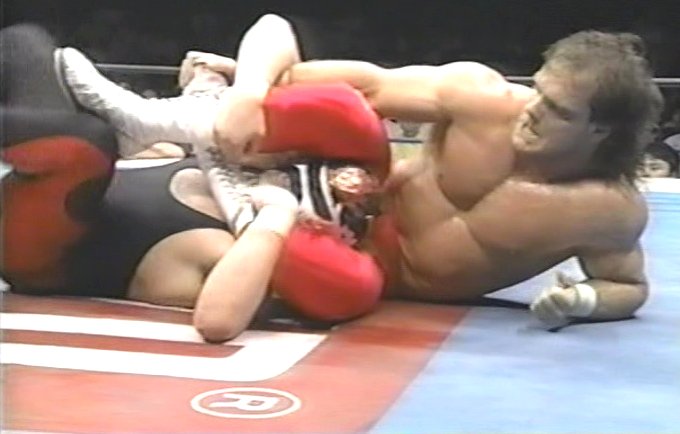 NJPW 7/7/95 Iwamizawa Sports Center, BOSJ II: Wild Pegasus vs. El Samurai 30:00.
DC: This match took place on the seventh day of the seventh month of the seventh year (of the Japanese Heisei era, which equates to the year 1995 on the Gregorian calendar). One of the reasons this match was great was that they didn’t necessarily work this like a 30-minute draw. From watching this match, you wouldn’t be able to tell until the final minutes or so that there was a good possibility this would go to the time limit. Another reason this was great was the fact that both these guys were so into what they were doing. They put over the idea they were out there in a competitive grappling contest and were struggling to get any sort of good advantage over the opponent. As the match went on, the intensity level seemed to increase, as both workers were making it harder for the other to get the upper hand. Overall, it looked like Wild Pegasus had things going his way a bit more than El Samurai did, but it was pretty even from start to finish. Pegasus was the stronger and more explosive of the two, but Samurai always had that never-say-die attitude and ability to rise to the occasion. Pegasus was definitely the better overall worker of the two, as Pegasus was arguably the best men’s pro wrestler in the entire world at the time, but Samurai was once again a strong opponent. The two had several matches against each other in the past, including a very memorable and quite excellent TOSJ IV final on 6/14/93. After a period that saw Pegasus be the more dominant of the two, Samurai managed to fight back a bit more, which simultaneously resulted in the beginning of the finishing stretch of the match. It was wonderful to see that Samurai still had it in him to work a match of this caliber after being somewhat put to the side by NJPW in order to give Koji Kanemoto and Shinjiro Otani more of a push. And it was absolutely splendid to see Pegasus give yet another strong performance, pushing the quality of the match to greater heights. Watching Pegasus 1995 matches makes you remember how enjoyable pro wrestling truly can be. Even during the final minutes of the match, the near finishes were so convincing that I had briefly forgotten that this was going to a time limit draw, even though I had been aware of the result of this match for many years. That shows you the greatness of these two workers. Of all the matches these two had together, this was the one they made the most of the time they were given, and they were given a really good amount of time here. Great match. ****¾
NJPW 9/23/95 Yokohama Arena: Wild Pegasus vs. Lord Steven Regal 20:47.
DC: Lord William Steven Regal showed his unique British-style urgency from the start. It was interesting to see him in a NJPW ring in Yokohama instead of in a WCW ring in Florida. Regal was quite the character and wrestler, as he was doing the over-the-top gimmickry in combination with very old fashioned English grappling. Wild Pegasus didn’t let any of that distract him, as he was his usual no-nonsense self. Regal was a heavyweight and wrestled like a heavyweight. Pegasus was technically a junior heavyweight, but he was a powerful one, and for this catchweight bout, he decided to emphasize a bit more his roughness and toughness. This is something we’ll end up seeing him do more often, as he’d soon start working for American 'rasslin' company WCW where he wouldn’t necessarily be working against junior heavyweights most of the time. Most people at the time were probably thinking Regal was weird/comical and kinda boring, while here and there some may have found his approach interesting. What really was the most interesting part about this match was Pegasus adapting to Regal’s style so well (which made sense, since Regal was too slow and not athletic enough to do a Pegasus style match), once again displaying Pegasus’ versatility. Regal’s style was at best a poor man’s less serious version of Billy Robinson’s style. The stiffness was noticeable more clearly when Regal started bleeding hardway. Regal also seemed to have hurt his leg. Pegasus really started taking it to Regal more and more, but Regal, while being carried by the superior Pegasus, was never dominated like a Koji Kanemoto. The Japanese crowd started laughing out loud when Regal tried to keep going for the cover. Regal would soon silence the laughter by going for an actual proper pinning combination that scored him the win. This match benefits from being an unusual novelty. Other than once again seeing how versatile Pegasus was, the match generally wasn’t as interesting as Pegasus’ bouts against fellow junior heavyweights, though. The match got a pretty good amount of time, but it felt like a lot of the time, this time wasn’t necessarily utilized very well. Good match. ***¼
NJPW 9/25/95 Osaka Prefectural Gymnasium, IWGP Junior Heavyweight Title: Koji Kanemoto vs. Wild Pegasus 17:14.
DC: This is an often overlooked or forgotten match that is an underrated gem in the history of IWGP Junior Heavyweight Title bouts. The main reason this match was so much better than their really good 3/13/95 match is that Koji Kanemoto seemed way more up for the task here, as he wasn’t just being dragged around and carried by Wild Pegasus as much as before. The match still relied mainly on Pegasus carrying things, but Kanemoto actually came across as a champ this time, and provided more useful resistance in this bout than we’d been used to seeing from him. Kanemoto was still the underdog, in spite of being the champion, but at least he didn’t feel like a completely unworthy champion. Pegasus showed that he was indeed the very best men’s pro wrestler in the entire world at the time, as he was having superb performances with a wide variety of opponents in matches that all had different stories to tell. Pegasus understood so well how to make Kanemoto’s shortcomings not be too visible, as he’d, for example, try to put over the idea that Kanemoto showed urgency and intensity on the mat when Kanemoto actually didn’t. Some of the biggest highlights came later in the match when Pegasus backdrop suplexed Kanemoto off the top and soon after went for a flying headbutt. Pegasus almost got the win when he went for another top-rope move, as he hit a diving headbutt for a near fall. Pegasus even hit a huracarrana off the top rope and a dropkick off the top rope. Kanemoto tried to put Pegasus away with a moonsault and a flying dropkick. The match was in a back-and-forth phase, and you’d get the sense things could really go either way. In the end, it was the former Tiger Mask III that scored the win over Pegasus via a tiger suplex. They really made the most of the match, and they really put this over as a big title bout. This was enjoyable and exciting pretty much from start to finish. Great match. ****¾
WCW 10/23/95 Huntsville, AL Von Braun Civic Center: Chris Benoit & Dean Malenko vs. Eddy Guerrero & Mr. J.L. 10:00.
DC: This took place on the eighth edition of Monday Nitro. Minnesota’s Jerry Lynn was a masked character called Mr. J.L. By this time, it was starting to become clear that WCW was having quite an interesting batch of junior heavyweight workers on their roster. Having Chris Benoit and Eddy Guerrero in the same match is always a great idea, and it was no surprise that their interactions resulted in crisp and fascinating pro wrestling moments. Everyone did some high flying, even Dean Malenko (as he executed a pescado). Malenko was very familiar with the work of Guerrero and Benoit, so his sequences with them were quite smooth-looking. I think Lynn would have been more over if he just worked as Jerry Lynn, but this mask was actually his own idea, the problem is the character was never fully developed, as they just haphazardly named him his initials. These guys did the most they could with the ten minutes they were given. They worked a match that worked well for live TV, as it featured a lot of action and lived up to people’s expectations of how junior heavyweights should wrestle. Benoit stood out most because of his ability to combine athleticism and viciousness. Guerrero was super spectacular during the moments he was in the match, thanks to his speed and cat-like agility. After the match, Brian Pillman, who was starting to show gradually more heelish and lunatic behavior, attacked Guerrero to set up a future match. Very good match. ***¾
WCW 10/25/95 Atlanta, GA Center Stage Theater: Chris Benoit vs. Eddy Guerrero 11:04.
DC: This was about as good as a WCW Saturday Night TV taping match could get. The week before, they had gone to a draw, but it looks like complete footage of that match isn’t available at this moment. These two were so awesome at the time, that it didn’t matter whether or not you’d put them in Tokyo’s Sumo Hall or at this TV studio in Atlanta, you could count on them delivering some of the best pro wrestling in the world. For this match, they focused more on a methodical approach with them trying to wear each other down and really milking each hold and move they executed. That being said, these two were so explosive that they couldn’t help throwing in some really cool fast-paced moments as well. It’s nice that each match they’ve had was different and had a different story being told. The crisp execution is what made these two stand out from the rest of the roster the most. This bout between these two evenly matched international competitors ended when Benoit used the ropes to his advantage to score the pinfall win. Very good match. ***½
WCW 10/29/95 Detroit, MI Joe Louis Arena: Chris Benoit & Dean Malenko vs. Lord Steven Regal & Earl Robert Eaton 8:41.
DC: You gotta love ‘90s pro wrestling. Everyone’s favorite Alabama hick, Bobby Eaton, had been repacked into a snobby nobleman to form the tag team "The Blue Bloods" with the English grappler Lord William Steven Regal. Their opponents were as non-gimmicky as you could get, though, as Chris Benoit & Dean Malenko were no-nonsense workers. Benoit executed a Silver King-esque dive amongst several other explosive-looking moves. Regal and Eaton were good workers, but they couldn’t match the speed of Benoit & Malenko. The match came to an end when Malenko dropkicked Regal to enable Benoit to execute a bridging dragon suplex for the pinfall victory. This match took place during an edition of WCW Main Event, which doubled as the countdown show of Halloween Havoc ‘95, which was a PPV that took place at the same venue WWF Survivor Series ‘91 had taken place. One of the most notable things about Halloween Havoc ‘95 was a decent match involving Brian Pillman that saw the reformation of the Horsemen (when Pillman joined forces with Arn Anderson to help Ric Flair betray Sting), a stable that Benoit would soon be joining. Good match. ***¼
WCW 11/6/95 Jacksonville, FL Coliseum: Chris Benoit vs. Eddy Guerrero 6:29.
DC: It had recently been revealed during a backstage promo video that Chris Benoit had joined Brian Pillman, Arn Anderson and Ric Flair as the fourth member of the Horsemen. This didn’t stop Benoit from being the best men’s wrestler in the world, and he proved that here in yet another match against the great Eddy Guerrero. During this match, which took place on the tenth edition of WCW Monday Nitro, NJPW’s Jushin Thunder Liger, Kensuke Sasaki, Masa Saito and Masa Chono were having supper with heel manager Sonny Onoo while enjoying the tremendous in-ring action. Of course, Benoit and Guerrero were no strangers to NJPW, as they had been touring NJPW extensively over the years. Both workers executed their moves with great velocity. One of the main highlights was Guerrero hitting a plancha to the floor. Guerrero also hit an awesome-looking brainbuster. The combination of these two being super crisp at executing their moves and them being very familiar with each other really helped make this match so smooth and so enjoyable to watch. Every time these two met in a WCW ring, it resulted in some of the best wrestling to have ever taken place in an American ring. It’s a shame they were only given six minutes here, but at least they made the most of the little time they were given. The finish was a little abrupt and a little screwy, but hopefully that means we’ll see another match between these two in the near future. This was one of those matches in which Guerrero showed that he was capable of being nearly as outstanding of an in-ring performer as Benoit was at the time. Good match. ***¼
WCW 11/26/95 Norfolk, VA Scope, U.S. Heavyweight Title: Kensuke Sasaki vs. Chris Benoit 10:01.
DC: In spite of neither man being from the United States (as Kensuke Sasaki was from Japan, and Chris Benoit was from Canada), this was a match for the United States Heavyweight Championship. This was certainly a lot more eventful than their 2-minute 11/6/95 Nitro match in which Benoit destroyed Sasaki. Benoit was probably the best wrestler in the world at the time, but Sasaki was just another decent NJPW heavyweight, so this wasn’t nearly as interesting as Benoit’s matches with guys like Jushin Thunder Liger and Eddy Guerrero. Bobby Heenan was on a role on commentary, as he rightfully mentioned that Benoit was better than Gene Kiniski, and that this incarnation of the Horsemen with Benoit and Pillman was the best version of the Horsemen ever. One of the highlights of this match was Benoit hitting a tremendous suicide dive through the ropes. Benoit also hit a tremendous flying headbutt. The finish was a bit disappointing, as Sasaki scored the win after just hitting a couple of moves in spite of Benoit dominating most of the match. Good match. ***¼
NJPW 12/11/95 Osaka Prefectural Gymnasium: Wild Pegasus & Dean Malenko vs. Sabu & Hiro Saito 14:11.
DC: Much to the crowd’s delight, Sabu wasted no time in using a chair, which set him apart from the rest of the NJPW junior heavyweight division, generally a division in which weapons weren’t used very often. Hiro Saito used to be a junior heavyweight back in 1990, and was still unimposing enough to be part of a tag team match that featured three junior heavyweights. In spite of the NJPW junior heavyweight division featuring a lot of the best men’s pro wrestlers in the world at the time, the general consensus was that the top heavyweight division guys were the main eventers. Sabu realized this, and that’s why he wanted to get out of these NJPW tours, as he had no interest in always being second fiddle to inferior heavyweights (especially since at the time, Sabu was universally considered to be one of the most spectacular guys around and a big reason for ECW getting more popular amongst hardcore wrestling fans). Hiro Saito was really not an ideal tag team partner for Sabu, as you almost couldn’t get more opposite from what Sabu was doing than what Hiro Saito was doing at the time. Hiro Saito was slow and unspectacular, useful for untelevised midcard tag team matches, but not the type you would want to have in a match featuring two of the most exciting workers in the world, Sabu and Wild Pegasus. Dean Malenko, on the other, was a much better choice. In spite of Malenko being quite boring as a personality and character, at least he was able to work fast-paced junior heavyweight sequences and was familiar with the more fascinating approach Pegasus and Sabu were going for. Pegasus was on a whole different level than virtually everyone else at the time, so he was able to even make the Hiro Saito segments watchable by simply beating the crap out of him and showing tons of intensity. In spite of being the dullest and most over-the-hill worker in the match, the wily veteran Hiro Saito scored the pinfall victory over Malenko, which made zero sense other than to emphasize that workrate and quality of work means less than bulk and weight. Very good match. ***½
WAR 12/13/95 Tokyo Ryogoku Kokugikan, Super J-Cup Quarter Final: Wild Pegasus vs. Lionheart 13:43.
DC: Alberta vs. Manitoba. Two Canadians in the quarter final of the 2nd edition of the Super J-Cup in Japan. Wild Pegasus had won the 1st edition of the Super J-Cup on 4/16/94, which was hosted by NJPW. This time around, it was the WAR league that hosted the tournament. It was the very first time these two had a match together. The story goes that Pegasus was so impressed with ‘Lionheart’ Chris Jericho, that he told Eric Bischoff about this "gem" he wrestled in Japan. Based on Pegasus’ recommendation, Bischoff hired Jericho in 1996, and the rest is history. Prior to his WCW run, ‘Corazon de Leon’ Chris Jericho was still trying to figure things out, but this big match against Pegasus certainly was a tremendous learning experience for 25-year old Jericho. I don’t want to make it sound like Jericho was a newbie at that time, as he had been noticed by wrestling fanatics due to his work in SMW, CMLL and WAR. However, those leagues weren’t always on everyone’s radar at the time. This second edition of the Super J-Cup was one that caught a lot of people’s attention due to the first-ever Super J-Cup being considered one of the greatest pro wrestling shows ever. Pegasus was easily the best men’s pro wrestler in the world at that time, and that certainly played a huge part in this match being so memorable. The way Jericho wrestled was with the intention of standing out and being noticed. You could tell from all the little details that he wanted people to go talk about his match after it was all said and done. Pegasus was such a great all-round performer that he was able to incorporate Jericho’s more mainstream-wannabe North American approach into his own more serious no-nonsense puroresu-influenced Stampede style. Jericho’s charisma thus only added to the match, and it didn’t take anything away from the match, thanks to both guys understanding how to make this match work. This was definitely a great match that exceeded expectations. While Jericho certainly wasn’t a Jushin Thunder Liger or even a Koji Kanemoto, whatever Jericho lacked in seriousness, he made up for in sincerity. Jericho was an interesting opponent for Pegasus, because Jericho’s hodgepodge-type style makes his work feel fresh and free. Pegasus gave one of his very best performances that year, which says a lot, since 1995 was arguably his greatest. The way Pegasus took the moves and sold for them was absolutely awesome. It’s one of the many reasons why Pegasus is one of the all-time greats. What they both did so well was put over this match as important. Most of the match was wrestled in a way that felt like it was going to bring someone closer to victory. Pegasus was more likely going to be the winner, but Jericho’s unpredictability and adventurousness made it seem plausible that an upset could take place. The match was totally fascinating from the second the bell rang until the second the match ended. Great match. ****½
WAR 12/13/95 Tokyo Ryogoku Kokugikan, Super J-Cup Semi-Final: Wild Pegasus vs. Gedo 9:20.
DC: Younger fans may know Gedo as the overrated NJPW booker. However, older fans will probably remember that Gedo was also super overrated as a wrestler back in the early days of the Super J-Cup (and throughout the rest of his career). In the 1994 edition, Gedo got his ass whooped by Pegasus in a short and easy win for Pegasus. However, due to politics, and due to Gedo being part of WAR at an event hosted by WAR, Gedo somehow won this match. Of course, Pegasus was the one who did all the hard work and carrying. That’s unfortunately something he would end up getting more and more used to as a WCW worker. Anyway, if you want to see how Pegasus carried a super overrated guy to a pretty good match, then go ahead and watch this. If not, then this is definitely skippable material. Good match. ***
Stu Hart Tribute Show 12/15/95 Calgary, AB Stampede Corral: Chris Benoit vs. Rad Radford 11:28.
DC: WCW vs. WWF! That’s right, a WCW wrestler wrestled a WWF wrestler in the middle of the Monday Night War-era. In Calgary, Alberta, the wrestling capital of Canada, Alberta’s own Chris Benoit wrestled Louie Spicolli, an American wrestler who had recently been repackaged by WWF as Rad Radford, an untidy grunge rocker. You can tell that Stu Hart was immensely respected by everyone in the wrestling business, because for a match between a WCW wrestler and a WWF wrestler to take place, hell must either freeze over or there must be a Stu Hart tribute show taking place. In this case, it was the latter option. Stu, of course, the father of a legendary wrestling family that included his sons Owen and Bret. Stu was also the founder of Stampede Wrestling, a league that was very much ahead of its time stylistically, combining elements of British wrestling and Japanese wrestling with North American wrestling. It was also the league that was the home league of the great Dynamite Kid for many years. Benoit idolized Dynamite and started wrestling in 1985 in Stampede. Benoit was one of two WCW wrestlers being allowed to appear on this show (the other one was Brian Pillman, who, just like Benoit, was a big star in Calgary during the ‘80s). Spicolli had mainly been either a jobber or lower midcard worker in most of the leagues he wrestled in, even in spite of being "Madonna's Boyfriend". Spicolli was a good worker, and facing arguably the best men’s worker in the world at the time was a big opportunity for Spicolli to show off his skills. It’s pretty incredible that WWF would allow a wrestler of theirs to do the job against a WCW wrestler. Of course, unfortunately, this was probably partially due to them not caring much about Spicolli. And it was partially because WWF knew that their top champion, Bret Hart, would headline the show and win the main event. And this was still before the days of every show being put online, as you would have to really go out of your way to get footage of this show back then. Benoit took this match seriously, like he always did, and that made this already way more interesting than any match Radford had in WWF. The awesome thing about Benoit was, when he looked across that ring, he didn’t see a gimmick, he saw a wrestler. And that’s how he treated the grungy Radford, like a wrestler, not a gimmick. They wrestled quite a good match here. Of course, as good as he was, Spicolli wasn’t quite on the level of Benoit’s opponents in Japan, but that made this so interesting. Once again, Benoit showed his tremendous versatility. Benoit stayed true to his philosophy of high workrate and high-quality work while subtly adapting his style for this match to enable the opponent to give their best performance possible. Spicolli’s work wasn’t as interesting as that of a Koji Kanemoto or even a Chris Jericho, but Spicolli’s passion for doing what he did shone through, and that’s what made his work so interesting. In very North American-style booking, Benoit won via a superplex, an awesome move but one he didn’t typically win matches with in Japan. I was going to say that it was fitting he won with a superplex because of it being a Dynamite Kid move, but, of course, pretty much every move Benoit did was inspired by Dynamite Kid. By the way, also on this show: 1-2-3 Kid beat Keith Hart with an inside cradle, Razor Ramon beat Owen Hart with an inside cradle, Brian Pillman & Bruce Hart beat Terry Funk & Dory Funk Jr. via disqualification, and in the main event, Bret Hart beat Davey Boy Smith via a rollup (in a match that wasn’t quite as good as their match on WWF PPV two days later). Anyway, while certainly worth watching, Benoit vs. Radford was more interesting and charming than actually recommendable. Good match. ***
WCW 12/27/95 Nashville, TN Municipal Auditorium: Chris Benoit vs. Jushin Thunder Liger 10:29.
DC: This was the opening match of the Starrcade PPV. And it was part of the ‘World Cup of Wrestling,’ which was a best of seven series between WCW and NJPW. This was great while it lasted, but they only got ten minutes, which is less than what they would usually get in NJPW. So, while this was a really good match, it was disappointing to those who were familiar with their matches from Japan. Chris Benoit and Jushin Thunder Liger did everything they could to make the most out of this match, though. Their execution, selling and in-ring storytelling was naturally great, as these two all-time greats were quite familiar with each other. They certainly didn’t waste any time. Even though this was disappointing compared to their Japanese matches, let’s not forget that this was quite the viewing experience for those who only watched American wrestling. So, when you look at it that way, this match certainly worked and delivered. It was a hot opening contest that set the tone for an interesting PPV. The finish of this Benoit vs. Liger match wasn’t great, but it was the only way the short match time would be explainable in kayfabe, as ‘Taskmaster’ Kevin Sullivan showed up (as Sullivan’s Dungeon of Doom stable had a feud with The Four Horsemen), distracted Benoit, and Liger got the pinfall win. Excellent match. ****
11/28/93 AJW: Bull Nakano vs. Hikari Fukuoka (JWP) 13:48
PA: Bull gave Hikari a platform, carried a smart enough match and she was happy enough to put her over. The problem was she didn’t actually add much to it beyond that. Bull did little else than wear down Hikari with holds and let her up to make her hot comebacks, which Hikari made the most of. It probably would have been an excellent match had Bull gave her the beating she’d give out when she was her most inspired. After the 10 minute mark, it turned into a really good match when Bull started actually trying to beat Hikari, and it became a competitive match. Hikari hit her hot moves, she didn’t get a credible near fall, but she took enough abuse from Bull before she was put away. ***
 11/28/93 AJW First Attack Captain Fall Survival War: Suzuka Minami, Akira Hokuto, Etsuko Mita & Mima Shimoda vs. Dynamite Kansai, Devil Masami, Mayumi Ozaki & Plum Mariko (JWP) 41:45
PA: This was Zenjo’s take on the 7/31 JWP match. They had the four one on one, five minutes segments and then it turned into a tag match. The singles matches were Devil vs. Minami, Ozaki vs. Shimoda, Mita vs. Plum and Hokuto vs. Kansai. Unlike 7/31, the single attack phase didn’t accomplish as much. Each of the mini-matches were good and built the rivalries, it also gave us an epic Kansai vs. Hokuto battle, which was the most dramatic of the four. There was stalling and tension building. Hokuto was just pure arrogance, and got put in her place as Kansai kicked the crap out of her knee. Hokuto fought back, but she didn’t have an answer for Kansai’s kicks. Kansai hit Splash Mountain as the time ran out. Transitioning into the tag match, the JWP team executed superplexes on all four Zenjo members from each turnbuckle to get it started. They went back and forth for a few minutes and then a small explosion happened. Minami managed to dodge a triple-dropkick only to fall victim to Plum's Rana, resulting in a two count. Minami inadvertently crashed into LCO with a cross-body, but she quickly regained control with a powerful Ligerbomb, securing the pinfall over Plum. It was now a handicap match, and it only got worse for JWP a few minutes later. Ozaki began using her heel tactics on Minami while Kansai landed cheap shots from the apron. Masami was accidentally taken out with a missile dropkick, and Mita and Minami thought they’d try a double team, but only got copped a lariat from Devil for their trouble. An attempted powerbomb on Mita was interrupted by Hokuto, and although Kansai tried to intervene, she was swiftly taken out once more, tumbling to the outside along with Devil. Shimoda and Hokuto were launched onto the JWP team, and Minami followed up with a tope that didn’t go to plan. Marine Wolves attempted a double missile dropkick, but Masami evaded, and ran through Hokuto in the corner. Kansai and Masami delivered a sandwich lariat to Hokuto, but a guillotine legdrop missed its mark, allowing Hokuto to capitalize with a victory roll to eliminate Masami at the 32:42 mark. The odds were stacked against JWP now with only Kansai and Ozaki against the entire Zenjo team. Ozaki got worked over with the Zenjo team doing whatever they wanted. They cheated, they cheapshotted Kansai, Hokuto flipped off the JWP president. Kansai came in and got double teamed and then ate four diving headbutts. Hokuto tried the Northern Light’s Bomb, but Kansai had other ideas and walloped her in the mouth. Hokuto was able to hit the DQ bomb though, but Ozaki broke up the fall. Hokuto went after her, but got nailed by Kansai. Ozaki did a powerbomb, but Shimoda broke up the pin, and Ozaki went after her. They clotheslined each other, and Ozaki missed a dropkick. Shimoda tried another clothesline, but Ozaki got behind her, and hit the Tequila Sunrise to take her out of the match at 37:29. Ozaki found herself double teamed and in trouble as the crowd chanted for her. She made a comeback on Hokuto, hitting a boomerang and a rolling senton. A powerbomb and stereo flying headbutts got a near fall. Ozaki went for a Tiger Suplex, but was cut off. Minami hit powerbombs, and Mita hit an Electric Chair, but Ozaki refused to die. She got the tag to Kansai, who thwarted a double team, taking both Minami and Mita out with lariats before eliminating Mita with a high angle backdrop suplex at 41:20. She immediately snatched Minami up in Splash Moutain with Ozaki adding a neckbreaker drop to it to eliminate the captain and get the win for JWP at 41:46. The match was great, it had so much cool stuff, much like the match at Thunder Queen, though it couldn’t be as good as that. They were all excellent in this, no matter how little they were in. The underdog JWP story was really well done, and unlike the LLPW tag from a few weeks earlier, it wasn’t overdone. Kansai just ended it quickly with two fast eliminations after Ozaki survived an onslaught. ****1/2
11/28/93 AJW All Pacific Title Match: Manami Toyota vs. Toshiyo Yamada 30:53
PA: Hokuto vacated the All Pacific belt, so they decided to have these two shoot out for it. Since 1/4/92 exists, it could only be their second worst televised match together up to this point (though all but the 1989 one were excellent to be fair). After you’ve seen their two good matches from 1992 there’s just nothing else to look forward to with them – you’ve seen the best they were capable of, and everything they could do, executed as well as they could. This match was good, but it was stretched out to 30 minutes. Another thing that really didn’t help was the Osaka crowd were quiet, so Toyota’s ridiculous screeching and screaming made it something I’d recommend watching with the sound down, she’s unbearable. By this point in their careers, they weren’t fooling anyone. Everyone knew what was a waste of time, and they were just waiting around for spots, so it took them past 20 minutes to wake up the crowd. The last 10 minutes were damn good though. They both hit their usual spots, and though Toyota didn’t have her cleanest day execution wise, she made the match this time. Yamada didn’t add much to it. In fact, she was the ‘dumb’ one, making more questionable decisions with her spots, and even killed the match briefly when it was cooking because she felt the need to spam half a dozen backdrop suplexes in a row, just to completely kill the move off and make sure no one ever reacted to it again (worse, she kept doing it as a regular spot). It was Toyota bringing the intensity, the better spots, better bump taking and selling. When Toyota’s Japanese Ocean Cyclone Suplex failed, it was the best part of the match, as she screamed at the ref, which fit the intensity she had shown building up to it. She couldn’t hit it again, as Yamada slipped out of her next attempt, and hit the Reverse Gory Bomb to get the win. ***1/2
11/28/93 AJW UWA World Women's Tag Title Match: Yumiko Hotta & Takako Inoue vs. Shinobu Kandori & Miki Handa (LLPW) 21:49
PA: This had more hatred than anything else on the show. It had the intensity. There was a lot of brawling. Handa took an enormous beating, with her and Takako both bleeding. They tried to make this a main event level match, but it needed Harley as Kandori’s partner. Handa did her job well, but she was no threat. Still, her and Takako were the best here. Hotta and Kandori spent most of the match on the apron, slow burning to their big confrontation at the end which wasn’t that good. Hotta did come to the party at the end though, and the finish was outstanding. Handa tried to fight off the Carribean Splash, but eventually got caught with it. Kandori broke up the pin, so Hotta proved herself genius by hanging Kandori up in the tree of woe so she couldn’t go anywhere, then hit the Pyramid Driver with Takako adding a clothesline to it on Handa to get the win. There was a lot to like here, but it really wasn’t big show main event caliber. ***
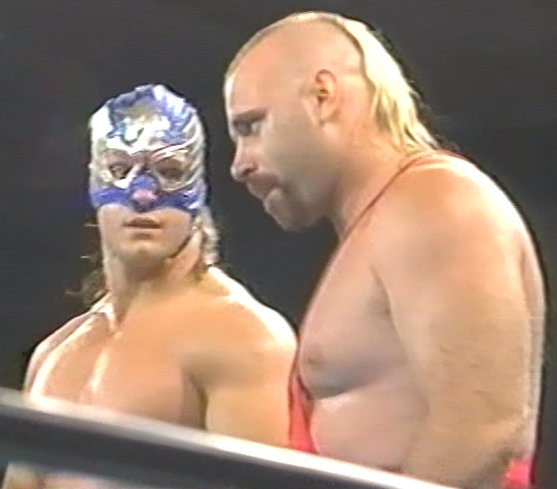 NJPW 7/19/90 Shizuoka Industrial Hall: Pegasus Kid & Biff Wellington vs. Hiroshi Hase & Kensuke Sasaki 12:51.
DC: All four of these guys wrestled in Stampede Wrestling at some point during the 1980s. The year 1990 was an interesting year for them. Hiroshi Hase had just started being taken seriously as a top heavyweight in NJPW. Kensuke Sasaki was still far removed from being the legendary veteran people would know him as, but he started climbing the ranks slowly. Pegasus Kid was about to reach true greatness and was about to become one of the best pro wrestlers in the world. Biff Wellington, however, was about to hit obscurity, and his name would end up only popping up here and there. Biff was a talented Calgarian, but his Dynamite Kid-wannabe style was perhaps too similar to that of the far superior workers Pegasus Kid and Owen Hart, who ended up becoming international superstars, while this July '90 tour turned out to be Biff's final overseas tour. The match was at its least smooth whenever Sasaki and Biff were in the ring together. They were definitely not bad wrestlers, but they were noticeably more clunky and less graceful than the other two in this match. The match was at its best whenever Pegasus was in, especially when working against Hase. This match was interesting, for sure, but it never seemed to reach its full potential, as we didn't get enough Pegasus vs. Hase. The match ended somewhat abruptly when Pegasus scored the pinfall over Sasaki. Good match. ***
NJPW 8/16/90 Chiba Park Stadium: Pegasus Kid & Super Strong Machine & Tatsutoshi Goto vs. Jushin Thunder Liger & Kuniaki Kobayashi & Kensuke Sasaki 12:47.
DC: We were just three days removed from the groundbreaking, bar-raising title bout between IWGP Junior Heavyweight Champion Jushin Thunder Liger and up-and-coming great Pegasus Kid. Whenever those two faced off in this trios match, they really put over the idea that they were indeed in a hot in-ring feud in which there was something important at stake. The interactions were brief, but that was understandable since they were merely meant as a preview or appetizer, if you will. Of the other four guys, only Kuniaki Kobayashi seemed to treat this match like it was more than just another midcard trios match, though. Pegasus pinned Kobayashi after the Dynamite Kid-inspired combination of a tombstone followed by a flying headbutt. Pegasus was clearly ready for the upcoming title bout against Liger. Good match. ***
NJPW 10/11/90 Tokyo Korakuen Hall: Pegasus Kid & Villano V vs. Owen Hart & Jushin Thunder Liger 13:40.
DC: The hand-held footage for this match is quite shaky, but it’s good enough to get a good impression of the match. They lived up to people’s expectations of junior heavyweights being spectacular high flyers. Jushin Thunder Liger and Pegasus Kid were two of the guys responsible for creating these expectations thanks to their tremendous in-ring feud that year. Liger’s tope suicida sent both him and his target, Pegasus, over the guardrail. Pegasus showed some impressive flying of his own, including a dropkick off the top to the floor. Owen’s work was super smooth, and his excellent execution made his work impressive-looking in spite of being slightly less spectacular than Liger and Pegasus. Villano V was the odd one out here, as he came across quite pedestrian compared to the three former Stampede Wrestling superstars. In fact, the crowd even started laughing when Villano did some weak-looking lucha holds, not realizing that the luchador was being serious. The match certainly slowed down a lot when Villano was in the ring. This didn’t stop the others from performing well whenever they were in, though. As the match went on, though, it became clear that the first half was the more interesting half, and this was confirmed when the match just ended somewhat randomly. Owen scored the win via flying elbow. Good match. ***¼
NJPW 10/29/90 Yokkaichi Civic Gymnasium: Pegasus Kid & Hiro Saito vs. Jushin Thunder Liger & Takayuki Iizuka 11:41.
DC: This was quite the exciting and action-packed tag team bout that took place three days prior to the big rematch between Pegasus Kid and Jushin Thunder Liger, who had an amazing all-time great match on 8/19/90 in which Pegasus had beaten Liger for the IWGP Junior Heavyweight Title. Pegasus showed tremendous intensity from the start, throwing Jushin Thunder Liger in the guardrail so hard that the guardrail almost came unhinged. Hiro Saito was still somewhat in his "prime", and he joined in on the fun and showed quite a bit of aggression. Once Liger was able to fight back, he did so in spectacular fashion. When he hit a tope suicida, he used his body as a torpedo-esque weapon that came at Hiro Saito in full force. The match felt like it was a really good companion to the Pegasus vs. Liger singles matches. This tag match wasn’t on the same level as the singles matches, but they functioned as an extension of the in-ring feud. It’s not necessarily an essential match, but it’s definitely recommended for fans who are into this Pegasus vs. Liger feud and want to get a more complete picture of what was happening in the NJPW junior heavyweight division during this very interesting time period. Pegasus, the IWGP Junior Heavyweight Champion, maintained the momentum he had been having at the time, as he managed to score the pinfall after a flying headbutt on Iizuka. Very good match. ***¾
NJPW 2/4/92 Hakodate Citizen Gymnasium: Pegasus Kid & Flying Scorpio vs. Jushin Thunder Liger & Akira Nogami 13:49.
DC: You could tell this match took place before the big 2/10/92 singles match between Pegasus Kid and Jushin Thunder Liger because everyone was quite intense and ready to go. Flying Scorpio and Akira Nogami had a few minor execution issues, but they were of the realistic kind, so it didn’t detract anything from the match. Pegasus was super smooth in his execution, showing everyone that he was indeed ready to have a great 1992. Liger, the top junior heavyweight in the world, was amazing in this match. What was so great here was that he was really into building up the heat for his big upcoming match with Pegasus. In the end, after a lot of exciting junior heavyweight action, Nogami pinned Scorpio to win the match. Very good match. ***¾
NJPW 2/12/92 Takaishi Seaside Sports Center: Pegasus Kid & Flying Scorpio vs. Jushin Thunder Liger & Akira Nogami 13:43.
DC: Pegasus Kid and Jushin Thunder Liger just had an excellent match against each other two days prior, and they made it clear that they were ready to pick up where they left off, as their sequences together were fast and exciting. Flying Scorpio and Akira Nogami were no strangers to each other either, but they didn’t have the heated rivalry Pegasus and Liger had. Liger had some nice-looking moments with Scorpio as well, but he would always make it clear that he preferred to face his rival Pegasus in the ring. While this was an enjoyable match, it felt like it never was a continuing whole. It was always just going to be about Liger vs. Pegasus with some random other stuff happening to fill up the rest of the match. If anything, this match just makes you long for another singles match between Pegasus and Liger, as their interactions together were super smooth. That being said, even the moments Scorpio and Nogami were in were always at least worth watching. Of course, you have to keep in mind that these two teams had a better match together on 2/4/92, which was superior to this 2/12/92 one because of it taking place earlier in the tour, prior to the 2/10/92 match, so the 2/4/92 match had a lot more meaning and purpose to it (and therefore naturally more energy and intensity). The match came to an end when Nogami scored the pinfall win over Scorpio. Very good match. ***½
NJPW 4/21/92 Kanazawa Ishikawa Industrial Exhibition Hall, TOSJ III: Pegasus Kid vs. Negro Casas 6:00 of 11:38.
DC: This was tons of fun. It was basically just two very talented international junior heavyweights doing fast-paced exciting junior heavyweight stuff. You can’t go wrong with that. They both put over the idea that they were just going to go all out and do risky stuff in order to get a victory, even if it would mean they’d come crashing down. This made this certainly very fun to watch, but it also meant the match lacked strategy and a deeper storyline. What also didn’t help was that only half the match is available, so now we’re getting even more the impression this was more like an exhibition of excitement as opposed to a well-crafted bout. Good match. ***¼
NJPW 11/23/92 Tokyo Ryogoku Kokugikan: Pegasus Kid & Dean Malenko vs. Jushin Thunder Liger & Takayuki Iizuka 17:37.
DC: Whenever Pegasus Kid and Jushin Thunder Liger were in the ring together, the wrestling looked amazingly crisp and graceful. These two great wrestlers had been in an in-ring feud together since 1990, and whenever they faced off, things still looked as fresh as ever, as it still felt they brought the best out of each other. The match was certainly at its most interesting whenever they were in the ring. Takayuki Iizuka was a solid worker, though, and he didn’t feel out of place. Iizuka was technically part of the NJPW heavyweight division, but, since he was one of the smaller heavyweights, it felt like NJPW would always book him as either a heavyweight or a junior heavyweight based on which division needed an extra guy to make the numbers even (and the same seemingly was sometimes the case for Akira Nogami before they became a full time team in 1993). Dean Malenko had only started teaming with Pegasus since October 1992, and this 11/23/92 match was actually the first televised show that had Malenko and Pegasus in the same ring (which would be the first of many, many times, as most of you probably know). It was a good idea to have Malenko team with Pegasus, since they were both no-nonsense gaijin workers that seemed to have good chemistry. This was only Malenko’s second tour for NJPW. He had previously wrestled for AJPW, usually teaming with his older brother Joe, and in spite of his overly serious approach (which fit AJPW very well), since he was rather small, he was a better fit for NJPW because NJPW actually cared about junior heavyweights (unlike AJPW). What was really cool about this tag team match is that things gradually became more urgent and speedy while putting over the idea the two teams were trying to outdo each other and going for the victory. Liger pinned Malenko to win the match. WAR’s Ultimo Dragon was sitting at ringside and appeared to be quite impressed. Excellent match. ****
NJPW 3/9/93 Akita General Prefectural Gymnasium: Pegasus Kid & Dean Malenko vs. Jushin Thunder Liger & El Samurai 14:01.
DC: These four were no strangers to each other, as these two tag teams had wrestled each other several times before in November of 1992. This tag team match from 3/9/93 took place on day one of Pegasus Kid’s first NJPW tour of the year 1993, which would end up being another outstanding year for him. Pegasus, Jushin Thunder Liger and Dean Malenko had just returned from an Australia tour, which was a tour headlined by guys like Jake Roberts, Don Muraco and Jim Neidhart. Here in this junior heavyweight tag team match that also featured El Samurai, Pegasus and Liger showed why they were two of the very best pro wrestlers in the world at the time, which they have been proving ever since their in-ring feud started three years prior. Malenko was a great tag team partner for Pegasus, as the two were both gaijin that were able to adapt to the sincerity of Japanese puroresu. El Samurai is a worker that’s often overlooked by pro wrestling fans, but he was a really good and reliable worker that was able to hang in there with some of the very best junior heavyweights of the world during the 1990s. While the work was generally really good, and the interactions between Pegasus and Liger quite excellent, the match never seemed to turn into a super memorable bout of its own. It did, however, give us a preview of the excellence that was to come from the NJPW junior heavyweight division that year, and it was a good preview for whenever the next Pegasus vs. Liger bout would take place (which was a match any true wrestling fan would always want to be looking forward to). Pegasus scored the pinfall win over Samurai via a tremendous dragon suplex to win this match. Very good match. ***½
NJPW 6/5/93 Mie Tsu-shii Taiikukan, TOSJ IV: Pegasus Kid vs. Flying Scorpio 11:00.
DC: The work was good, but the match lacked the urgency and intensity we’re used to seeing from these two. This wasn’t a bad match by any means, but it was probably the most disappointing match they ever had together, especially considering their TOSJ II and SuperBrawl III matches were really good. It was interesting to have a look at this match for the sake of completion, though. Literally, during the final minute, they decided to all of a sudden do some stuff that would be worthy of inclusion on a highlights video. Flying Scorpio won the match via pinfall after a moonsault. Good match. ***
NJPW 6/15/93 Tokyo Nippon Budokan: Pegasus Kid & El Samurai vs. Ultimo Dragon & Dean Malenko 15:43.
DC: With the exception of a couple of battle royals, this was the only time that Chris Benoit was in the same match as Ultimo Dragon. Also, this was the final time Benoit wrestled as Pegasus Kid, as from his next tour in August ‘93, he would be known as Wild Pegasus. And this was the first time that Benoit and Dean Malenko were not on the same team in a tag team match (which possibly explained the smirk on Benoit’s face when they were facing off). Apart from all these novelty facts, this tag team match wasn’t as good as it looked on paper. It took place the day after the prestigious TOSJ IV tournament had been completed, so that probably had something to do with this being slightly underwhelming. The wrestling wasn’t bad by any means, but this match simply lacked any real sort of fire and determination. The match ended when the teamwork between Dragon and Malenko resulted in Malenko pinning Samurai. Good match. ***
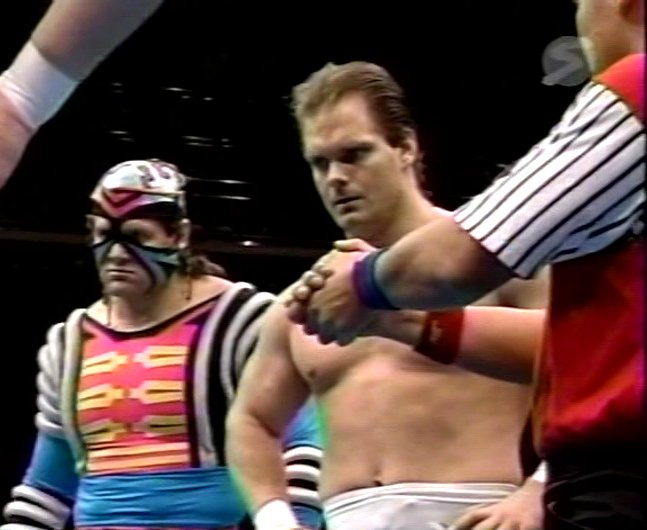 NJPW 2/17/94 Tokyo Ryogoku Kokugikan: Wild Pegasus & Max Moon vs. El Samurai & Shinjiro Otani 11:57.
DC: What an unusual sight it was to see former WWF Superstar Max Moon in a NJPW ring team with Wild Pegasus. Max Moon was the Croatian-Canadian wrestler Paul Diamond, who used to be the tag team partner of Shawn Michaels before Michaels became a (Midnight) Rocker. Some of you may also remember Diamond as the masked character Kato, one half of the WWF tag team The Orient Express with his former Bad Company partner Pat Tanaka. You gotta love how the NJPW crowd just kinda yawned and didn’t seem to care that there was a guy dressed up in a space outfit trying to be taken seriously as an in-ring performer here at the Tokyo Sumo Hall. What really matters, though, is that Max Moon did quite well here, as he was capable of working some good-looking sequences with El Samurai & Shinjiro Otani, two excellent workers who had been quite reliable forces in the NJPW junior heavyweight division. Max Moon’s tag team partner, fellow Canadian Wild Pegasus, delivered the high-quality work you’d expect from him in 1994. After having had a stellar 1993, Pegasus showed no indication that his work in 1994 was going to be of any less quality. Once you get past the excitement of the idea that Max Moon was in a very good NJPW match, we’ll have to admit that Max Moon was the weakest member of the match, sometimes even slightly dragging the match down. That being said, this was a match worth watching and probably should be considered above expectations since you initially wouldn’t really know what to expect when reading the line-up for this match. So yes, this was a fun match, mainly for the novelty factor, and it was a match worth watching either way, but this match probably didn’t really make anyone wish that Max Moon would become a regular in NJPW (and he would actually end up being back for one more tour in July of 1994, his final tour of Japan). In the end, it was Max Moon’s team that won this match, as Pegasus pinned Otani. Very good match. ***½
NJPW 5/26/94 Tsu City Gymnasium, BOSJ I: Wild Pegasus vs. Shinjiro Otani 10:36.
DC: This was the opening night of the Best Of The Super Juniors (I) tournament. It was the first year that the tournament was named BOSJ, as during prior years, it was called Top Of The Super Juniors. Wild Pegasus had won TOSJ IV in June of 1993 (when he was still called Pegasus Kid). Pegasus had also won the Super J-Cup in April 1994. Shinjiro Otani was still a lower midcard young lion, but one who showed excellent potential and was slowly but surely climbing the ranks. He would end up placing 7th out of the 11 participants in this 1994 BOSJ I tournament. Otani showed he was eager to prove himself, and his ‘if you don’t try, you won’t succeed’ type attitude made him a sympathetic young underdog. Pegasus, on the other hand, being the decorated competitor that he was, had quite a lot of confidence in his own ability. So, while Pegasus was definitely not holding back, he was definitely not in a rush to beat Otani as soon as possible. Otani took advantage of the opening given to him, as he started to bust out a springboard dropkick and a German suplex. Pegasus now realized that maybe it was a good idea to start going for the win. Pegasus hit a dragon suplex, but that didn’t put Otani away. Otani went for another springboard move, but Pegasus was prepared this time and stepped away. Both workers executed their moves very well. Their facial expressions were also superb, as it made it easy to get lost in their performances. All of this helped create a vibe of serious sportsmanship, and that’s exactly one of the aspects that made 1990s junior heavyweight pro wrestling so interesting. Pegasus went for his flying headbutt, but Otani moved away just on time. The match had reached a climax of excitement just in time for Otani to score a flash pinfall win. The crowd was clearly shocked by the result. A big upset victory for Otani after a really good performance. Things were looking good for him. The great Pegasus could afford this loss, and that would make his next matches in the tournament more interesting and less predictable, since he was an obvious top favorite. Very good match. ***¾
NJPW 6/1/94 Sendai City Gymnasium, BOSJ I: Wild Pegasus vs. Dean Malenko 14:04.
DC: These two usually team up in NJPW, so this was actually only the second singles match in NJPW between the two (and the first one was during the previous year’s TOSJ IV tournament). Wild Pegasus and Dean Malenko had excellent chemistry together, as tag team partners and as opponents, so it’s a good thing their career paths would be quite similar, as they would end up working together in NJPW, ECW, WCW and WWF. Malenko was a guy who was able to work exciting flash sequences, and he generally was quite good at having a feeling for how to work a memorable match. The main downside of Malenko was his rather dull character and relative lack of crispness. Like, he would execute moves well, and his sequences often looked good, but a lot of similar workers would often execute similar moves in a more crisp manner. Another thing about Malenko’s work that gets repetitive after seeing a lot of his matches is that he wasn’t as versatile as his top peers, and the opponent was more often than not kinda forced to adapt to the Malenko style match. The action wasn’t as exciting as in Pegasus’ best bouts from that year, but they did a good job of putting over the amount of struggle they were presenting. Pegasus survived a Dory Funk Jr.-like Texas cloverleaf and then missed a flying headbutt. Malenko still couldn’t put Pegasus away, though. In the end, it was Pegasus who won via an inside cradle that looked like a desperation move, which fit nicely with the story of ongoing struggle they were telling. Good match. ***¼
NJPW 6/6/94 Chiba Koen Taiikukan, BOSJ I: Wild Pegasus vs. Black Tiger II 4:10 of 13:38.
DC: The wrestling looked very smooth and full of life. And this appeared to be an excellent match, but only 4 minutes were shown. ***¾
 11/18/93 JWP Pure Heart Meets The Dangerous Queen, Only One Time Singles Match: Mayumi Ozaki vs. Akira Hokuto 18:26
PA:
Hokuto's involvement with JWP was relatively limited during the rivalry year. This was her first real interaction with JWP, and she gave about the same amount of respect she’d shown to LLPW. You’d think putting the two best workers of 1993 against each other would have great results, it didn’t get up to that level though. Ozaki didn’t have her best performance, there was nothing wrong with her work, she did all the moves fine but the attitude wasn’t there. She seemed intimidated by Hokuto when she should have matched and upped her nastiness as she would have done with anyone else. It turns out that there’s some things you can’t bluff; Ozaki really was in awe of Hokuto. She said in an interview that wrestling Hokuto was different, she had an aura like no one else and all she could think of when she was in the ring with her was “wow, it’s Akira Hokuto”. The focus of the match was Hokuto's knee, as usual, and Ozaki effectively targeted it throughout the match. Hokuto's selling was top-notch, and the second half saw an escalation of big moves. They sold the big moves and made most of what they did meaningful. At one point, Ozaki powerbombed Hokuto outside and waited in the ring, taunting her doing jumping jacks so Hokuto even made that into a revenge spot later, doing pushups after her somersault plancha. Ozaki never really had a chance to beat Hokuto, but they managed to put that in doubt with a kneebar she caught towards the end. She had a run where she had to counter Hokuto and eat a DQ bomb, but ended up hitting the Tequila Sunrise for a near fall. That was really it for Ozaki’s hope, and they went home straight after, with Hokuto avoiding a cannonball, hitting the Henkei backdrop and a Northern Light’s Bomb to quickly finish. This was far from the best match they could have had together, but it was still a really strong and smart match in terms of structure, execution, selling, and it had enough drama. However, what was lacking was urgency. As mentioned earlier regarding Ozaki's persona, and for Hokuto’s part she was rather subdued compared to her performances from earlier in the year. These two having a match of this quality despite neither being anywhere near their best should tell you all you need to know about how great they were, but it’s hard not to be a little disappointed by it. ***3/4
 11/18/93 JWP Most Special Persons Wrestling Jam: Devil Masami & Plum Mariko vs. Chigusa Nagayo & Cuty Suzuki 33:07
PA:
This was the real main event of this show, which is saying something when you had Ozaki vs. Hokuto and Kansai vs. Kyoko on the card, and this wasn’t even an interpromotional match. It was however, the proper return of Chigusa Nagayo, after returning for the two Dream Slam shows to promote her movie (which bombed) she didn’t return for Legacy of Queens as planned, but ended up joining JWP (I believe specifically as an exclusive freelancer). Special would be the way to describe this match. Immediately Chigusa entered, and it was like the 80s again. There were enough schoolgirls (I suppose they had grown into women by this point) in the crowd to give it that atmosphere. The opening staredown from Devil and Chigusa had more substance to it than Hikari and Toyota’s entire match. The master plan unfolded with Plum attacking Chigusa while she was preoccupied by Devil, but their quick double-team attempt was thwarted when Chigusa evaded it. Chigusa dumped both out and teased a dive, and then the match got underway properly. Cuty found herself on the receiving end of some basic offense and heel tactics. Chigusa wasn’t happy with the heel tactics and Plum relished in taunting her, teasing Cuty with the tag before cruelly pulling her away. Devil and Chigusa had their first proper confrontation, and it was careful. They built the tension and heat. Plum got a kneebar on Chigusa and Chigusa played face in peril, when it looked like she was going to make the comeback in a figure four leglock. Devil ran in and stomped, then did a great Jumbo Suplex where she suplexed Cuty onto Chigusa. Chigusa hit a powerbomb and leg lariat on Plum to set up her sharpshooter. Devil came in to cut it off, but Chigusa never released the grip and put it on her. Plum got worked over for a bit, which was only really notable for introducing the sleepers to match, while Cuty’s wasn’t particularly effective, Devil made sure to interrupt Chigusa’s. After Cuty tried to quicken the pace, Plum countered her and tagged Devil. Cuty surprisingly managed to get the best of Devil briefly, avoiding a lariat and coming up with a Dragon Suplex which was a great near fall and set up Chigusa to take over. Chigusa unleashed a leg lariat on Devil and locked her in the Sharpshooter. However, Plum's interference prompted Chigusa to break off and attack her, allowing Devil to take over again with an Electric Chair double team with Plum hitting a seated senton. Plum put a dragon sleeper on Chigusa, but she snapmared her way out of it. Devil press slammed Cuty and dragged Chigusa into a powerbomb, she hit one but then Chigusa started countering her. Chigusa was too predictable with the leg lariat but Devil was too predictable with a lariat, and they both evaded. After Devil’s lariat attempt, Chigusa caught her with a kick to the back of the head, and Cuty came off the top rope with a flying knee. Cuty tried to finish off Devil with another Dragon Suplex and Chigusa helped her with a kick, but Plum intervened and Devil escaped. This was so perfectly built up now that Plum put a kneebar on Cuty that people really believed it was the finish, Devil took out Chigusa so all Cuty could do was hang on. The only criticism of the spot was that it probably went on too long, but Plum’s kneebar was never a protected move (though it probably should have been). Eventually, Chigusa avoided Devil's baseball slide and high kicked her, which allowed her to save Cuty. Devil and Chigusa got into an argument while Plum had Cuty in an STF, which was actually the more credible of her submissions in the sense that she’d actually won matches with it before, but the kneebar was more over and the STF was just used as filler. Chigusa got the hot tag soon after and took it to Devil, but Devil turned her high kick into a half crab. Chigusa came back grabbing Devil’s foot when she went for a kick and landed a bunch of strikes. They did a TKO tease of Chigusa's elbow. The first great sleeper spot followed with Chigusa getting it on Devil with Plum trying to break it up and Cuty doing her best to keep her away. Soon after, Devil did an even better sleeper spot. Devil jerked her around and Chigusa was not only looking like she was about to go out, but started frothing at the mouth. Cuty ran in and Plum got rid her. It was so good that it should have been the finish, but it did make things academic. Chigusa endured two powerbombs, and Cuty suffered one for her efforts to disrupt the pin. Plum attempted to set up Devil for a guillotine legdrop with a German Suplex, but they had to execute the move twice due to positioning issues. Devil got another near fall with a German suplex before pinning Chigusa with a guillotine leg drop, sealing the victory. Devil gave one of her best performances in terms of leading the match, and she was the standout. Plum wrestled the match of her life, being the workhorse and her submissions were worked into the match as major spots. Chigusa was a little rusty but significantly better than she was on the April shows, offensively she did enough, and her selling and apron work was tremendous. Cuty had the lesser role, but did a really good job as well, and made her moments count. This is 1993, so this doesn’t quite make a women’s match of the year contender. It is however, the best non-interpromotional women’s match of the year. ****3/4
11/18/93 JWP Full Throttle Thunder Queen World: Dynamite Kansai vs. Kyoko Inoue 20:46
PA: This match is more than good enough as a main event, but they had some trouble following the previous match, and like Hokuto vs. Ozaki, it was a little hard to buy Kyoko as a threat to Kansai coming in. In a perfect world, you’d have had Kyoko vs. Ozaki and Hokuto vs. Kansai, but at that point it would have been an arena card. This was the battle of the Splash Mountain vs. The Niagara Driver, but ultimately it was about the firepower to hit it. The first half was a lot of weardowns with some spots interspersed for transitions. Kyoko managed to do a pretty impressive giant swing considering Kansai’s size. Things weren’t really established until the second half. Kyoko had Kansai pretty well scouted, but it was Kansai’s kicks that made the difference. Kyoko could counter them, but couldn’t counter enough of them. The last few minutes were mostly all Kansai, with Kyoko hitting desperation suplexes and flash pins. She almost hit the Niagara Driver, but Kansai got out of it. After Kyoko’s flash pin attempt, Kansai rocked her with another kick, and that was enough to hit a backdrop suplex and then the splash mountain to put her away. This another well put together and well executed match. ****
11/7/85 WWF Wrestling Classic Tournament Quarterfinal: Randy Savage vs. Ricky Steamboat 3:19
ML:
A nice start to the program. It was good for what it was, obviously very incomplete, but showing the vast potential of the matchup. They were fired up, and fought an urgent and aggressive sprint that energetically and enthusiastically told the face vs. heel story. There was passion behind Steamboat's chops, and with such a small amount of time, they could do a few exciting rope running sequences without sitting in the arm bar too long in between to recover. Savage kicked out of the diving body attack, and knocked Steamboat out with brass knuckles while Steamboat was suplexing Savage back into the ring. They reused the framework of the match for their second match on 12/7/85, which was one of their worst because the tone was too sedated/ Pretty much everything they added was juxt to stretch that match out for another 8 minutes. This left you wanting more, that left you wanting less.
7/27/86 WWF Intercontinental Title: Randy Savage vs. Ricky Steamboat 15:23 of 19:06
ML: This wasn't as exciting as their best short match, but didn't become dull sitting way too long in arm bars like their worst long match. It actually felt like a complete match in the sense that it had enough bursts to be entertaining, without either being too brief sprint to amount to much or too padded to maintain interest. It was quite a good mix of the main things they do together, using quick running segments to set up the next hold, often an arm drag by Steamboat. The hold allowed them to rest while still passing off the illusion that they were continuing to fight, rather than exposing the business by turning their back on their opponent and whining about the audience. There's more downtime than I'd like, but within the sphere of pro wrestling, I basically believed in what they were doing. As with most of these matches, Steamboat was on the offensive the vast majority of the time, with Savage appearing to have few if any advantages over The Dragon beyond his willingness to cheat, but somehow retaining the title nonetheless. I don't need yet another 50/50 match, but since both guys are good at what they do but neither guy has that many actual moves, it does feel like a limiting factor that makes their matches more samey than they need to be. Since they had a lot more time than usual though, the match was a bit more unpredictable because it didn't take the first or most obvious out to come to a conclusion. There was a triple sell spot after Savage crashed Steamboat's head into the referee's. This luckily didn't lead to the usual screwjob, but rather the ref was just late enough in recovering that Steamboat couldn't get the pin with a small package. Steamboat inexplicably started arguing with the ref after the next near fall from his backslide though, and Savage, who was bloody from being posted earlier, blinded Steamboat by raking his eyes with a foreign object. Savage somehow didn't manage to capitalize though, and instead got back body dropped to the floor. Savage rammed Steamboat's head into the table, and ran his back into the side of the ring, but somehow Steamboat came out victorious by count out, despite not actually doing anything to Savage on the outside. ***1/2
10/28/86 WWF Intercontinental Title: Randy Savage vs. Ricky Steamboat 7:03
ML: This was a classic WWF injury angle, the infamous crushed larynx, but there was shockingly excellent wrestling to back it up first. You knew a WWF TV match in the mid 80s between two actual stars was going to have a bs finish, but they actually did a sprint with their best stuff prior to the angle. Savage being a lot more athletic than the typical heel led to this match being considerably more active than the typical WWF Ricky Steamboat match. Running was a key component of all of their encounters, but there was more focus on the brief bursts of activity leading into the requisite stationary holds, and less time spent in the lock. This isn't as deep as their 7/27/86 match, but they were firing on all cylinders, and action is on an another level. The downside of these 80s matches is the high spots off of the running weren't very spectacular, but that's more than made up for by the fight actually continuing because they would lead to a hold rather than stalling. Even if the wear down hold is boring, it still feels a lot more like an actual fight someone is trying to win than a posing contest, and in this case the action would pick up again pretty quickly as this lock was escaped or countered. Steamboat was winning all these running exchanges, often with his deep arm drag into an arm bar, but Savage finally caught him with a reverse diving body attack. Savage is usually still the better athlete even though he's the heel, but that wasn't the case here. Steamboat really owned Savage until Randy made it dirty. Savage accidentally took out Dave Hebner when Steamboat leapfrogged him. Hebner recovered in time to make the count after Steamboat's diving body attack, but heel ref Danny Davis stopped the count, trying to replace him. Steamboat started arguing with Davis, and took a flying knee in the back from Savage for his trouble. Savage dropped Steamboat throat first on the guardrail, then did the patented double axe handle with Steamboat's neck still draped over the guard rail. Steamboat pretended to be unable to breathe, acting like he was swallowing his tongue, and the bell rang, so Savage got the bell end came off the top rope with it. Hebner prevented Savage from coming off the top with the bell a second time, and they tried to stretcher Steamboat off, but he was falling off because he was gasping for breath. This was over the top cartoon stuff, but forgivable given the severity of supposed injury. Apparently Steamboat was counted out because Savage broke his own count re-entering to leap off the top rope. This matched didn't air until 11/22/86, so they had at least 9 more house show singles matches together before Steamboat was officially out injured. This was short and overbooked, but worked at a high pace with surprising urgency, especially for a match with a big angle, and the angle was actually not only memorable, but gave them something to incorporate into future matches, and changed the tone of the rivalry from Steamboat's quest to win the title to his need to get revenge. ***1/2
11/8/86 WWF Intercontinental Title: Randy Savage vs. Ricky Steamboat 12:53
ML: The running sequence was the basic motif of the match that they sometimes used for repetition, but other times used for progression.
It set the tone for the match, with Steamboat either getting the arm drag and further injuring the arm on the mat or Savage flooring him with a good shot such as a lariat or elbow. Savage eventually got right back up after the arm drag before Steamboat could settle in, ramming Steamboat's head into the turnbuckle and hitting the diving axe. Steamboat had success switching to using the shoulderblock while on the run, until Savage wised up to that and used his momentum against him to throw him over the top rope. Steamboat avoided the patented double axe handle to the floor though, and Savage was counted out for injuring his knee. This ending was a bit abrupt, but very reasonable as count out finishes go. Steamboat then did what he should have done 30 seconds earlier, dragging Savage back into the ring and pinning him after a flying chop off the second, but now it was just empty symbolism. This definitely wasn't their most exciting match, but I liked that it was more structured and better constructed than most of their others. ***1/4
1/10/87 WWF Intercontinental Title: Randy Savage vs. Ricky Steamboat 6:10
ML: Steamboat is very emotional here, which leaves him more prone to errors. This was a sprint where Steamboat wanted to kill Savage, and was happy to go for the throat. He's still willing to use some of his usual offense, so there's some good fast-paced action as well. This started out like it could be their best match, but turned when Steamboat took a bump over the top rope onto the steps. Steamboat was on the floor for most of the rest of the match because Savage jumped him a couple times when he started to recover. Steamboat eventually brought a chair into the ring and elbowed the ref when he tried to stop him from using it, leading to the DQ. The last few minutes were the weakest portion of the match, and it just ended way too quickly to even just really capitalize on the brawling Savage did or get full value out of Steamboat losing it.
2/15/87 WWF Intercontinental Title: Randy Savage vs. Ricky Steamboat 13:39
ML: Steamboat was still looking for revenge, even above bringing home the gold. He came out on fire throwing his chops, and this always stayed in grudge match territory, with Savage being on the run, but eventually winning the cat and mouse game. They did a good job of telling the story, but Steamboat showing his violent side certainty wasn't a story that took full advantage of what they had to offer. They did the brawl well though, and just being better athletes and wrestlers elevated the level. It's not necessarily the match I wanted, but it's the match that made sense at this point. It's a different match than what they were doing in 1986, and while a lot of these ideas were utilized in there 1/10/87 match, they were more fleshed out here since this was twice as long. Steamboat tracked Savage down until it backfired on him, and Savage would go after the crushed larynx at times. They spent a lot of time on the floor, building up to the patented double axe handle with Steamboat's throat draped over the guardrail, but Steamboat countered it with a punch. Steamboat dropped Savage's neck on the top rope for revenge. Savage bled from getting catapulted into the steel post. The finish was a series of flash pins back and forth until Savage used the tights to reverse the O'Connor roll and steal the victory. This match had a lot of emotion, and both played their roles really well. Steamboat is still very effortless even though he was mostly just getting his chops in, and Savage did a nice job selling and bumping. ***
3/29/87 WWF Intercontinental Title: Randy Savage vs. Ricky Steamboat 14:35.
ML: I was never that impressed with this match even when I first saw it as an 11-year-old who hadn't seen much wrestling beyond the WWF. My reaction 6 years later when I discovered all the hoopla about it's supposed greatness through WON was, for real? Having enjoyed this feud quite a bit more than I was expecting to going through everything I could find, I was now expecting that it was probably better than I remembered, but it actually feels more disappointing. Their previous matches that just focused on a single theme were ultimately much more effective matches. I don't like every match they did, but I feel like a lot of the others had better attention to detail. This match has aspects of their past matches, but it felt like they just kind of cut and pasted these things into some pretty standard brawling that didn't exemplify what makes either of them legendary wrestlers. I'm not a blood person, but given Savage was bleeding on the house show matches leading up to this, the lack of blood probably also kind of contributed to the grudge match aspect that was the bulk of tonight's concept feeling a bit too tame and laid back this time. Steamboat can clearly do this energized I'm just going to kill you with my chops stuff a lot better than he did here. Calling this quantity over quality would be unfair because it's all relatively good, but it felt like they were going at 60-70% most of the time rather than going 95% then resting in the armbar. I definitely prefered the down time being Steamboat holding an arm than someone laying on the floor because they were always effective going in and out of his hold, making for dynamic changes of pace, and the hold was still actually fighting on some level rather than someone just laying around when their opponent could have been pressing the advantage. Steamboat didn't seem as convincingly out for revenge this time, and they didn't shift the urgency we normally got from their running sequences into their brawling. I feel like they should have structured this as a series of segments from their other matches starting off with Steamboat's technical wrestling, moving into the running bursts (of course the 1st two can go hand and hand still), doing the flashpin sequence, and then having Savage lose his cool trying to finish or just injure Steamboat with the bell leading to just beating the hell out of each other until Steamboat catapulted Savage into the post to knock him out. This match just seemed all over the place to me. I feel amidst their other matches you will find better technical wrestling, better bursts of action, superior focus and structuring, and more heated brawling, among other things. This wasn't just a repeat of what they did before, overall it was probably more different, which is in its favor for the most part. That being said, it was less flashy and exciting, less focused, and less intense than their best stuff. This focused most on being a grudge match, but it never felt like they truly committed to that. In the leadup, you believed Steamboat wanted to hurt Savage 1st, and win the title 2nd. This match was sort of the opposite, but they failed to convey that in a manner where you saw a shift. I mean, there weren't story points of Steamboat choosing to try to win rather than to try to inflict punishment, he was just not as enthusiastic and eager to kick Savage's ass tonight. The grudge match style obviously doesn't really utilize the talents of the performers to the best of their abilities, but I can see the logic of saying, this is the big PPV match, we need to make it the special blowoff and really dig the strikes, do a good job of incorporating the ring post, guardrail, bell, blood. Granted, that's more of an NWA match, but they were more serious about making it feel like they were trying to hurt one another in some of their past matches, and the highs of the technical and athletic wrestling weren't as good either. Compared to the other post crushed larynx stuff, it largely felt more meandering and less electric. Having George Steele in Steamboat's corner didn't help. They spent more time on the outside, but most of that wasn't really fruitful, and it led to a finish that, while finally actually being a pinfall, somehow felt less satisfying than a lot of their screw jobs that actually felt like decisive cappers to the story they were telling that match. As always, it was quite impressive when they were on the move, but this match had more dead time than most of their others, and the running sequences felt more like nice diversions this time than the great highlights they should be. The biggest difference tonight was that Savage finally got more offense because he wasn't retaining this time. I liked that in the other matches, Steamboat was the control guy, but Savage would flatten him when he got something in. Savage did put Steamboat down a lot, but a lot of this played into the meandering on the floor with Steele, rather than being a big momentum changing transition as it was in the past. Savage catching Steamboat out of their running exchanges was always a highlight of their previous matches, partially because Steamboat winning the exchange with his arm drag was the common result, so Savage flooring him with a surprise elbow or lariat to turn the tide was a decisive point. This match just felt less focused to me to the point of kind of being all over the place. A lot of things happened, but it felt more like doing a little of everything they could rather than making their options truly work for them. They did a nice job again with the flash pin attempts. Savage theoretically could have won after his diving elbow drop, but Dave Hebner was down from crashing into Steamboat when Savage reversed the Irish whip. Savage then decide to try to take Steamboat out again with the timekeeper's bell, but Steele made the save trying to just take the bell away. Savage blindsided Steele with a kick to the back of the head though, and descended the top rope, but Steele recovered in time to push him off. Gorilla Monsoon tried to claim Savage landed on the bell, which clearly wasn't the case, but Steamboat nonetheless just pinned him countering a bodyslam into a small package. Obviously this is considerably better than anything else on Wrestlemania 1-3, but I don't see it as a landmark match that puts together the things they'd been doing well together into something greater. It was simply a more high profile match that was historic for the title change. ***