NJPW Super Warriors in Yokohama Arena ~NJPW 20th Anniversary Special Event~ |
Kotetsu Yamamoto & Kantaro Hoshino vs. Hiroyoshi Yamamoto & Black Cat 10:00. This was Kotetsu Yamamoto’s only match in 1992. He looked in tremendous shape for a 50-year old former wrestler. But of course, he had spent quite some time training people in the NJPW and JWP dojos over the years. Kantaro Hoshino looked like a shriveled up version of his former self, but he was still able to play the role of the sympathetic babyface quite well. This was actually Hoshino’s final year as an active full-time wrestler. Hiroyoshi Yamamoto was the future Tenzan, and had been wrestling for only a year. He was clearly green, but he showed potential. Black Cat was a solid luchador who could work the NJPW style quite well. This was an interesting match-up, and the Yamaha Brothers did well for themselves in spite of being years removed from their prime. Yamamoto executed a flying cross body press off the top rope that got quite the reaction from the crowd. This opening match did a good job of getting the crowd warmed up and providing them with some entertaining action that was solid enough. Okay match. **¼
Strong Kobayashi & Seiji Sakaguchi vs. Umanosuke Ueda & Tiger Jeet Singh 6:48. This was a match featuring four people who made their name in this business in the 1970s. Prior to the match, they showed some highlights of what they used to be like. Tiger Jeet Singh never did anything that resembled wrestling, so he was possibly the least deteriorated of the four. Umanosuke Ueda did a watered-down version of the heel stuff he used to do. This was his first match since 1987. Shozo Kobayashi didn’t look that strong anymore and could barely walk. This was his first match since 1981. Seiji Sakaguchi was okay but barely got to do anything, as the majority of the match was the heels beating up Kobayashi. The work shown in this match was not good at all, but at least they were moving around and doing something during the six minutes this lasted. Bad match. *¼
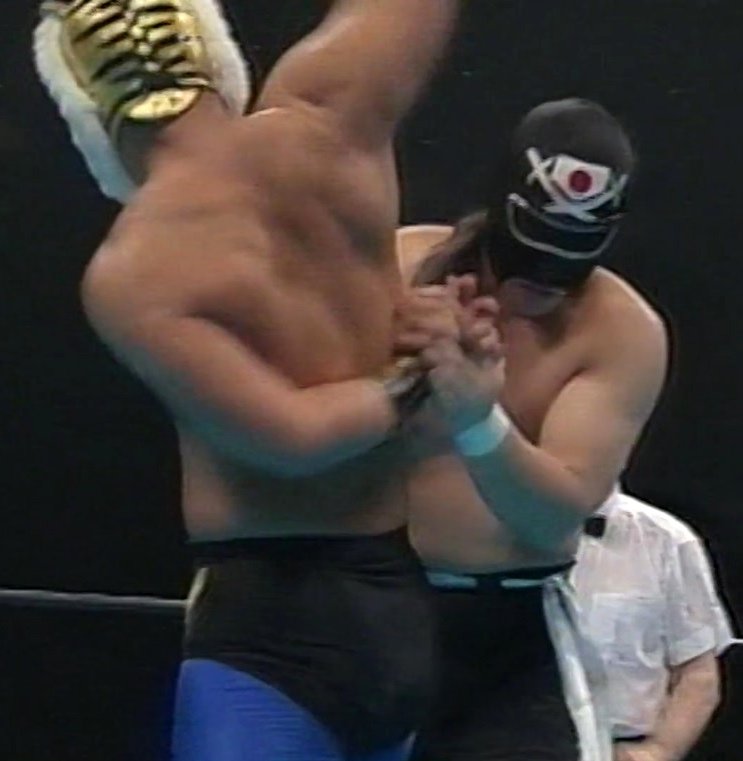 El Samurai vs. Tiger Mask III 8:31. Prior to the match, they showed highlights of the First Tiger Mask (Satoru Sayama) in his 4/23/81 match against the great Dynamite Kid. This was Koji Kanemoto’s first match portraying the third incarnation of the Tiger Mask gimmick. He would only appear a few times as Tiger Mask III during 1992, as he would continue to wrestle under his real name for most of the year. And this was Osamu Matsuda’s first match with the Samurai gimmick in a NJPW ring. He had been working as El Samurai during a 10-month excursion to Mexico at LLI shows, but this was his big NJPW debut as El Samurai. Kanemoto had been a pro for a little over a year and was still learning. Samurai had been a pro for five years and was hitting his prime. To make this match more special, they turned off the lights and shone some blue-colored light during the opening 35 seconds of the match, which was enough for Kanemoto to throw some kicks, mess up the tiger feint and then hit a pescado. Kanemoto was essentially a greener version of the original Tiger Mask, showing impressive skills in an inexperienced and somewhat clumsy manner. Stylistically, Kanemoto was a much better fit for the gimmick than AJPW’s Mitsuharu Misawa (Tiger Mask II) was, though. The mysterious Samurai focused on trying to control his opponent through solid grappling. He also did a good job of being a base for Kanemoto’s flips and flops. Kanemoto seemed to have a rough time working with this mask, as he was constantly trying to adjust it. Samurai didn’t seem hampered by his mask in any way, and was quite smooth. Samurai’s plancha from the top to the floor was executed with tremendous urgency and grace. Considering everything, Kanemoto showed a lot of potential. His tiger suplex looked great. Samurai was very impressive, the worker of the match, and showed that he was without a doubt someone to keep an eye on during 1992. The match served its purpose of introducing the new characters and giving the already hot NJPW junior heavyweight division some more newfound energy. Very good match. ***½
Osamu Nishimura vs. Satoshi Kojima 9:15. Both rookies were still in their early 20s and had been pro wrestlers for less than a year. On the DVD version of the show, this is the first match they show, as this bout featuring these two Young Lions was the least high-profile match on the card. They do a lot of basic grappling at the start of the match. What they do all makes sense, it’s just not very intriguing because they still didn’t really believe in themselves yet, and this made it hard to get the crowd to care. Satoshi Kojima was the one who showed more conviction. Osamu Nishimura’s offense looked weak, partially because he was so tiny back then. That being said, Nishimura’s dropkicks looked really good, and it was fitting he won via a superbly-executed dropkick off the top rope. The finish looked good, but the rest of the match looked like an exhibition between two youngsters trying their best to not screw up. Mediocre match. *½
Michiyoshi Ohara vs. Brian Blair 8:29. This was the sleeper match of the show. B. Brian Blair, the former Killer Bee, was still wearing bee-colored gear. The grappling in this match was some of the best grappling of this show. Blair was an accomplished amateur wrestler prior to his professional career, and it showed, as he was constantly trying to either attack or defend. Michiyoshi Ohara came from a judo background, and he showed strong reactionary skills. Blair was a 14-year veteran, while Ohara had been a pro less than two years. Blair took the lead and guided the youngster to a very well-worked match. Ohara provided the energy and strong style athleticism that made this match so dynamic. There was no time wasted, and both men clearly cared about giving a good performance. In the end, Blair’s experience shone through and got him the win. But Ohara looked impressive in defeat. Good match. ***
Shiro Koshinaka vs. Akira Nogami 10:45. Shiro Koshinaka once again proved he would give a strong performance no matter what his position on the card was. The talented Akira Nogami was one of those workers NJPW wasn’t utilizing very well, and NJPW wasn’t sure whether to book as a junior heavyweight or heavyweight. Both guys made the most of this random midcard match. To their credit, they could have easily phoned it in, but instead, they gave purpose and meaning to their moves and made this match work. Good match. ***
Shinya Hashimoto vs. Masahiro Chono 18:10. For the first minute or so, they pretended they’re going to have a good match, but then they decided to slow things down and waste a lot of time. Shinya Hashimoto’s nose started bleeding out of nowhere, which made the match briefly look a bit more dramatic than it was. Hashimoto did some stuff while Masa “he’s-not-my-hero” Chono was napping. Once Hashimoto went for his nap, Masahiro Chono did some stuff. It was all very dull and lifeless. They were more interested in killing time than actually doing something more useful. The way they mailed this in was almost disgraceful. The final thirty seconds of the match were good, though, but they weren’t good enough to cancel out 1000 seconds of boredom. Mediocre match. *½
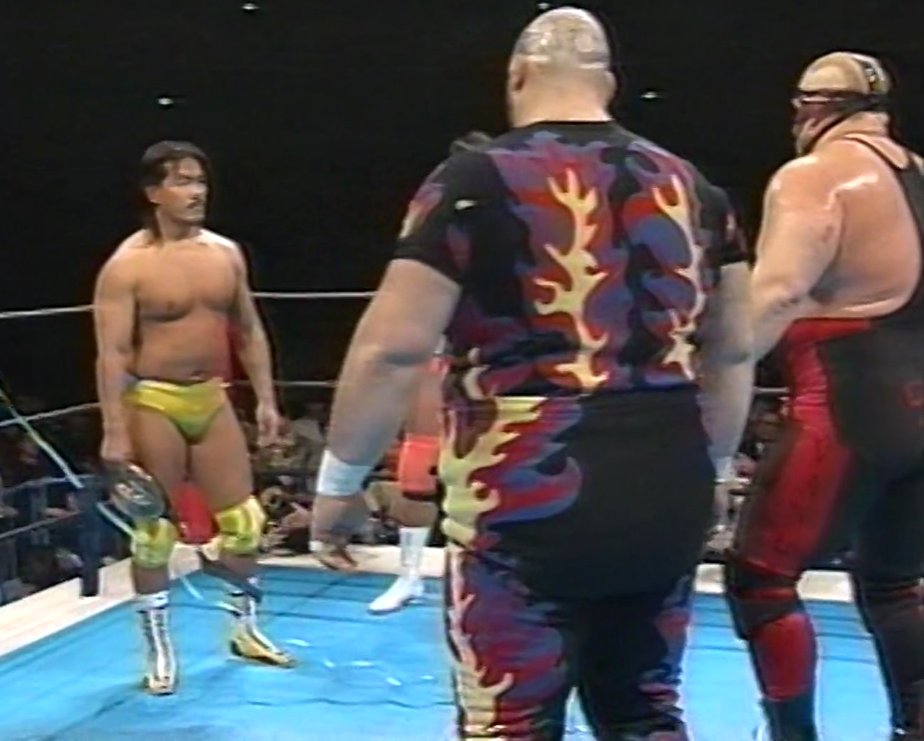 IWGP Tag Titles: Keiji Muto & Hiroshi Hase vs. Big Van Vader & Bam Bam Bigelow 24:48. The IWGP Tag Team Champions defended their title and belts against two American super heavyweights. Big Van Vader and “Crusher” Bam Bam Bigelow were both guys who were more agile than they looked. Bigelow’s performance was really good here, as everything he did added something to the match. Keiji Muto was good at letting the Americans do their stuff while playing his part and showing impressive offense when it was the right time. Vader utilized his monster aura very well, and he was very impactful. Hase’s selling and timing were superb. Hase was really good at being impressive while making the opponent look strong. The moves in this match looked very good, but it was the way they built up to them and reacted to them that made it all work so well. There was no time wasted, and it really was a well-crafted battle. There wasn’t a lot of urgency shown during the part that saw the gaijin team in control for a significant amount of time, but there didn’t need to be, as they were emphasizing their dominance through to their size advantage. The comebacks by Hase and Muto were timed and executed very well. Vader’s splash off the top rope on Muto was executed superbly. Bigelow’s flying headbutt on Muto looked excellent. The Americans did a great job of being dominant while still putting over the comebacks by their opponents as dangerous. All four guys were important to this match, but Vader was arguably the worker of the match. This was easily the best match of this show. Excellent match. ****
Antonio Inoki & Osamu Kido vs. Riki Choshu & Kengo Kimura 28:00. This was one of three matches the legendary Antonio Inoki would work that year. He gave a solid Inoki performance here. This meant that what he did made sense but wasn’t very exciting to watch. Osamu Kido hadn’t been useful since the late 1970s, so he was about as uninteresting and unimpressive as expected here. He was easily the weak link of the match. Riki Choshu showed the energy of a headliner. He picked his spots and worked in a smart manner. It was good to see the ever-reliable Kengo Kimura in this big main event. He had the unenviable task of being the one designated to try to make Kido look passable. Kido would eventually get pinned by Choshu. The main downside of the match was that it was too long, certainly longer than it needed to be. Don’t fall asleep. Mediocre match. *¾
Show rating: 6.5/10.0. Good show.
YouTube Review Playlists